
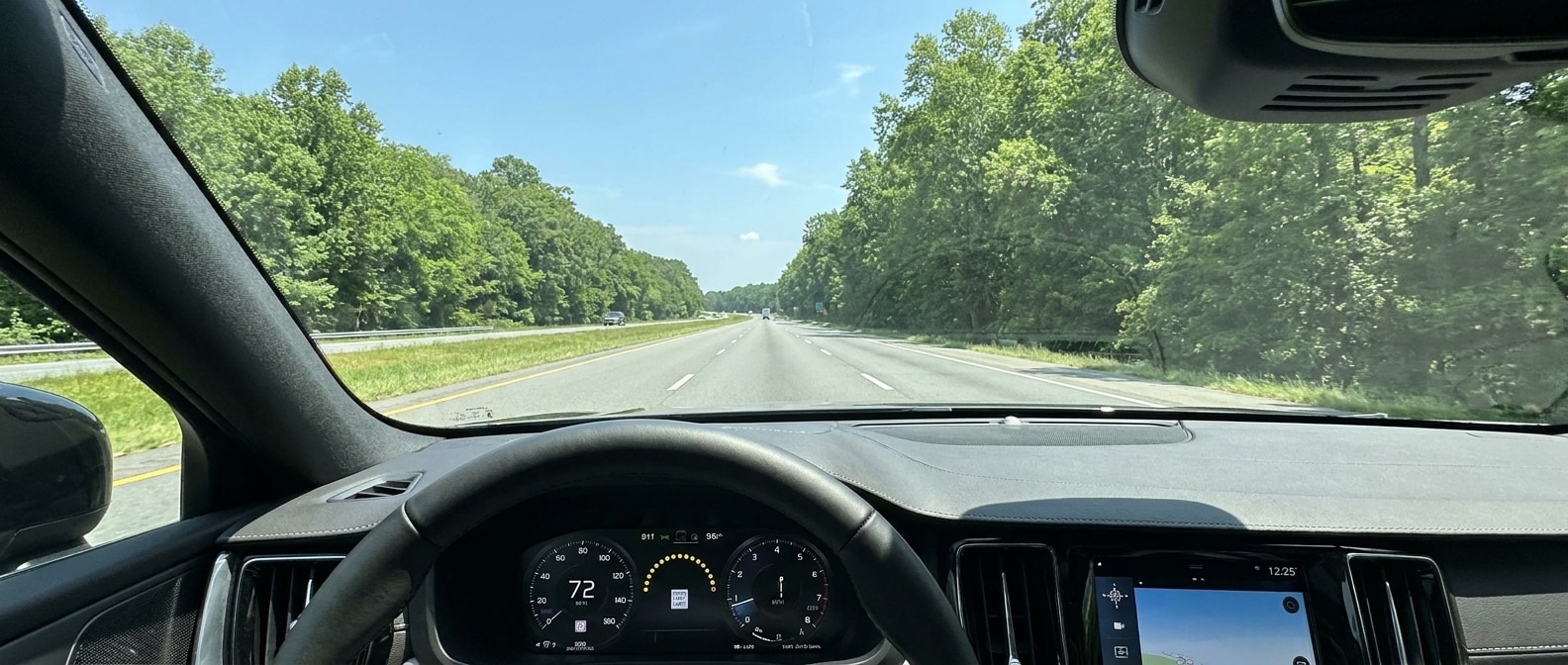
Volvo doesn't rely on one speed limiter. Three of them run at once, stacked on top of each other, and each handles a different job. Knowing which layer is live at any given moment changes how the car behaves under your right foot, especially on a corridor like I-85 where merge points and posted limits can shift inside a quarter mile.
The Volvo XC60 carries all three systems as standard equipment on the 2026 model, and here's what each one actually does.
Start with the bottom layer, the hard cap. Per Volvo's stated safety commitment, every new Volvo since 2020 tops out at 180 kph (roughly 112 mph). You can't adjust it, it never resets, and there's no override. Volvo's Safety Centre described this as the company taking "active responsibility" for traffic safety beyond what regulation requires. On every road you'll drive across Upstate SC, that cap stays invisible. It only matters at speeds no public highway allows. Which is the whole point.
The Do and Don't of Volvo's Active Speed Tools
The middle layer, Intelligent Speed Assist (ISA), is the one drivers actually notice working, since it reads posted speed limit signs through a forward-facing camera and cross-references GPS data, then flags the moment you've drifted past the detected limit with any of the responses in the table below.
| Situation | What ISA does | What you control |
|---|---|---|
| Passing a lower speed limit sign | Audio chime + flashing limit symbol in driver display | Acknowledge it and adjust |
| Sustained speed above the limit | Optional adaptive pedal resistance (pushes back gently) | Turn adaptive pedal off in settings |
| Unknown or unmapped road | No ISA response (no data = no warning) | Nothing needed |
| Temporary construction zone sign | Camera may catch it; GPS may not have it yet | Stay alert independently |
| Wanting to disable for this drive | Press the ISA button on the steering wheel | Resets automatically next drive |
Give ISA a fair shot on a longer run before you write it off. The stretch of I-385 where the posted limit drops before the overhead gantry comes into clear view is exactly where we've watched that audio cue earn its keep, and drivers who stick with it past the first week tend to lean on it there. Don't assume the off switch is permanent, though. That button on the steering wheel pauses ISA for the current trip only. Start the car again, and ISA comes right back on for the next trip.
The One Technique That Changes How Care Key Works
The Volvo XC90 and every other model in the lineup carry a third layer called the Care Key, and it rewards a closer look because it's both the most capable of the three tools and the one drivers most often misread.
The Care Key is a secondary key fob that lets the car's primary profile holder set a custom top-speed ceiling for anyone else who drives the car. You configure the limit through the center display under Profiles, and that yellow dotted arc on the speedometer marks exactly where the ceiling sits. Only the admin profile, the primary key, can adjust or deactivate it. Whoever holds the Care Key can't touch that setting.
The practical range runs from 30 mph up to the 112 mph hard cap, in one-mph increments. For a parent handing keys to a new driver, that's something far more concrete than a talk. For someone lending a car to a friend with a lead foot, it's a quiet, unannounced boundary, nothing more. None of this is punishment. The car simply holds a line while the conversation happens on its own.
We'd push drivers to stay clear-eyed about this. The Care Key won't stop every bad decision. A new driver can still follow too closely, roll a stop sign, or let attention slip. Speed is one variable, and the Care Key manages that single one. Pair it with real instruction rather than leaning on it as a stand-in.
On I-85 and I-385 specifically: Greenville County records some of the highest crash totals in South Carolina, and speeding and aggressive lane changes on those corridors show up as consistent contributing factors. NHTSA's 2024 data puts speeding as a factor in 29% of all U.S. traffic fatalities nationwide. No three-layer system guarantees safety on any road, and this one doesn't pretend to. What Volvo's setup does is pull a set of bad-outcome scenarios off the table, quietly and automatically.
The fully electric Volvo EX90 shifts the interface a little. ISA on the EX90 can be switched off for the current drive through the center display under Quick Controls, so that model doesn't need the steering-wheel button the XC60 uses. The reset behavior stays the same. Every new drive, the system comes back on.
Speed Management as Standard Practice, Not a Feature You Buy Up To
Every Volvo on our lot arrives with all three layers standard and no trim premium required, so you're not buying up to any of it, and that means the hard cap is permanent, ISA runs the moment you start the car unless you pause it, and the Care Key ships with every set of keys straight from the factory.
The tradeoff is worth naming. ISA can misread a sign or fire on a stretch where the GPS limit data lags behind a recent change. It backs up your attention rather than standing in for it. When it gets something wrong, you override it, drive the road correctly, and the system resets itself for the next trip.
What the system handles well is the category of unintentional creep. The slow drift over 75 on I-85 when traffic opens up. The 45-mph school zone on the way home you've passed so many times it barely registers anymore. A quiet nudge handles those.
Volvo's speed management comes down to three distinct tools, not one. Knowing which layer is doing what makes you a sharper driver, and it's what makes the whole system easier to live with on the roads you actually drive every day.
Categories:
Social