
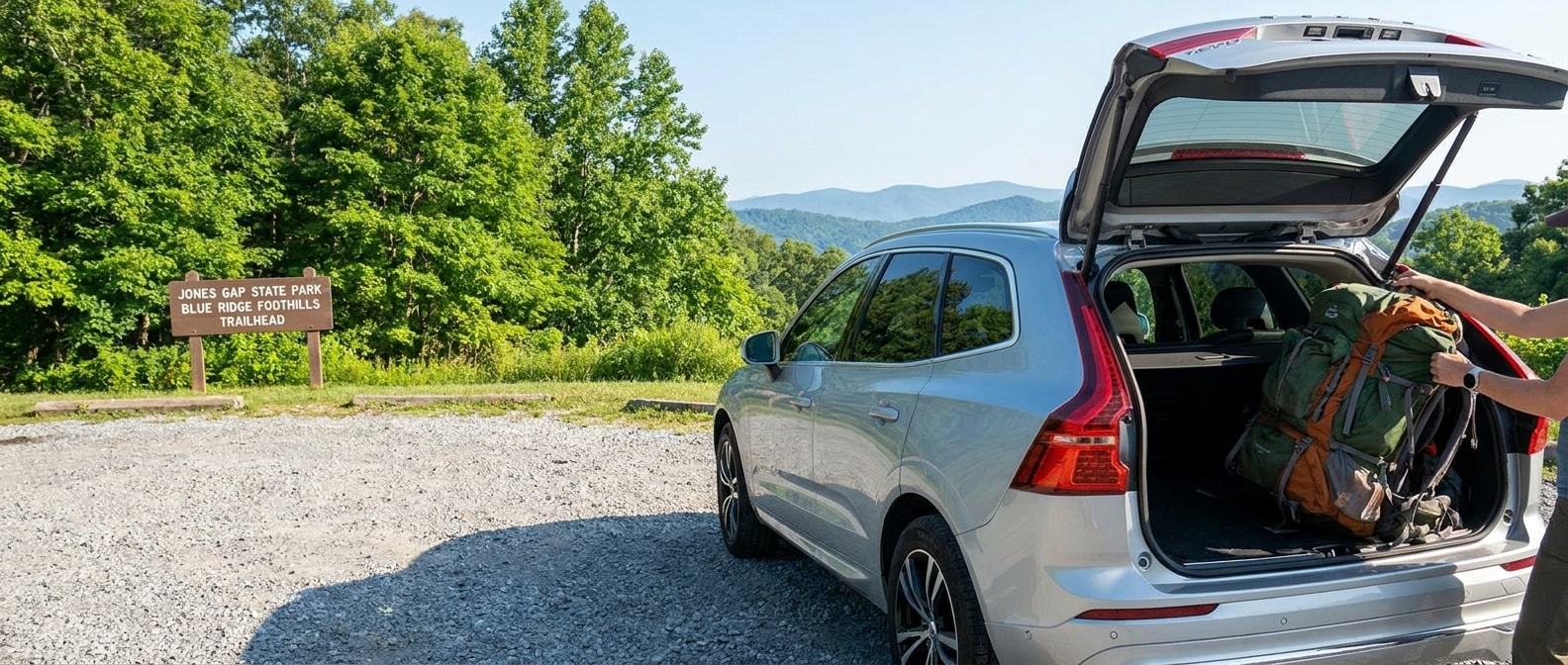
Pull up to the Paris Mountain trailhead on a Saturday morning and you'll watch the same small drama play out. Someone wrestles a 50-liter pack over a hard sill, bangs a knuckle on the tailgate lip, and sighs. Solvable problem, all of it. Volvo starts from a different assumption than most luxury SUVs, and the assumption is that the floor should be wide, flat, and lip-free from bumper to seatback, with a tailgate that opens hands-free when your arms are already full.
For most Greenville drivers headed to Paris Mountain or running SC-11 on a weekend, the 2026 Volvo XC60 hits the sweet spot. If you typically travel solo or with one partner and want a more compact footprint, the XC40 delivers the same design logic with easier trailhead parking.
The 2026 Volvo XC60 offers 21.6 cubic feet of cargo space behind the rear seats on a flat, wall-to-wall, no-lip load floor, with a hands-free kick tailgate: the combination that makes loading muddy packs after a trail day far less of a production.
We carry the full Volvo lineup here on Duvall Drive, and during a cargo walkthrough the one detail our team keeps coming back to is the load-floor geometry. The 2026 Volvo XC60 shows exactly why that matters, with 21.6 cubic feet of usable space with the rear seats up, a floor that runs wall-to-wall without the wheel-well intrusions you'll find in several competitors, and a sill with no protruding lip.
Why Does Volvo's Cargo Design Fit Upstate SC Trail Life?
Volvo's cargo design fits Upstate trail life because the priorities line up with what a trailhead actually demands, a wide flat floor and a hands-free gate, though you do give up a little of the squared-off van-like volume some rivals brag about. The table below maps the conditions a Greenville driver faces on a typical trail weekend against the Volvo feature that handles each one. None of it's accidental, and it shows up in the cabin every time you load for Caesars Head or a Blue Ridge day trip.
| Local condition or use | The Volvo feature that handles it | Why it matters here |
|---|---|---|
| Loading muddy packs after a Blue Ridge trail day | No-lip flat load floor (XC60, XC90) | Slide the pack straight in rather than hoisting over a sill; protects your lower back and the vehicle's finish |
| Hands full of trekking poles and water bottles | Hands-free kick tailgate (XC60, XC90) | A foot sweep under the bumper opens the gate; no setting gear down on a gravel lot |
| Two passengers plus two full hiking packs | 21.6 cu ft behind rear seats (XC60) | Fits a pair of 50-liter packs with room for sandals, a day cooler, and a trail map |
| Family of five heading to Lake Hartwell with real gear | 85.7 cu ft max with rows folded (XC90) | Absorbs the full group's load without roof racks |
| Solo or duo, smaller footprint for crowded trailheads | 20.1 cu ft behind rear seats (XC40) | Same flat-floor logic, easier to park at a packed Paris Mountain lot |
| Long, awkward items like trekking poles or a rolled pad | 40/60 split-fold with center pass-through (XC60) | Center seatback section opens for length without surrendering both side seats |
| Lower lift-in height for heavy coolers and gear bins | Wagon hatch at 59.2 in. tall (V60 Cross Country) | Closer to hip height than an SUV; the easiest single-hand-lift load in the lineup |
The XC60's Flat Floor Is the Detail That Earns Its Keep on Every Trip
The flat floor earns its keep because a rigid-framed pack loads clean on an uninterrupted surface, and that's a daily win, even if the styling costs the XC60 a bit of the boxy max-volume number a squarer SUV would post. Pack geometry is underrated. A 50-liter hiking backpack with a rigid frame doesn't want to go in at an angle; it wants to sit roughly upright or lay flat on a surface that isn't interrupted by stepped wheel wells. Volvo lists the 2026 XC60 at 21.6 cubic feet of cargo volume with the rear seats up, and that floor runs wall-to-wall without intrusions. The seats fold 40/60 and lie completely flat, which opens the space to a Volvo-listed maximum of 63.3 cubic feet, and the center through-hatch handles items that need extra length.
The hands-free tailgate deserves a fair word. Plenty of convenience features sound better in a brochure than they perform on a gravel lot. The Volvo version earns its name. When you're carrying a pack in one hand and a hydration bladder you're trying not to drip on your seats in the other, a foot sweep under the bumper opens the gate cleanly.
We'll put it plainly. The 2026 Volvo XC40's 20.1 cubic feet behind the rear seats is the tradeoff you accept for its smaller footprint. Plenty for one or two large packs and a cooler, and the cargo area is tall enough that upright stowage works. But put three people in it, each carrying a 40-liter pack plus shared camp gear, and you'll run out of floor before you run out of people. That's the limit of the XC40, stated fairly.
Volvo Cars USA describes the 2026 XC60's cargo area as featuring "a wide shape, no lip landing and flat floor," with 40/60 split-folding rear seats and a center through-hatch for extended items.
For Bigger Loads: Two Models, Two Distinct Problems They Solve
The XC60 starts to feel tight in two scenarios, and each one points to a different Volvo rather than a bigger version of the same idea, so the smart move is to match the problem to the body style instead of chasing raw cubic feet. First, a full-family run where you're carrying passengers in all rows and still want serious gear. Second, gear that's awkward in shape rather than just heavy. Different problems, different Volvos.
The 2026 Volvo XC90 handles the first scenario. With all seven seats occupied, Volvo lists approximately 10.6 cubic feet behind the third row. Fold that row down and you've got 34.6 cubic feet, and fold both rear rows completely flat and Volvo's maximum figure is 85.7 cubic feet. For a family heading to Lake Hartwell with a full passenger count, you can drop the third row and still carry a real load.
The XC90 keeps the flat floor and no-lip design from the XC60. Under the load floor sits an extra compartment for valuables or trail shoes you'd rather not set next to a clean seat.
The 2026 Volvo V60 Cross Country solves the second scenario. The wagon format produces a lower load sill than any of the XC-series SUVs. At 59.2 inches tall, the V60 Cross Country puts the hatch opening closer to hip height. When your gear is heavy (a base-camp cooler, a large duffel, a gear bin), the wagon's 18.3 cubic feet standard and 60.5 cubic feet maximum with the 40/20/40 split seats folded give you the volume, and the lower lift-in height gives you the mechanics to get it in without straining. Good choice for drivers who load heavily more than twice a week and care about the daily physics of it.
The XC40 for Greenville's Tighter Trailheads and City-to-Trail Days
The XC40 makes the smaller-is-smarter case for drivers who arrive early and park tight, though you trade away the XC60's extra floor to get there, which is a fair swap only if your crew and your gear stay light. Paris Mountain State Park is in Greenville County. Its main trailhead lot fills fast on summer Saturday mornings, and the XC40 at 174.8 inches long is noticeably easier to slot into a crowded lot than the XC60 at 185.4 inches. That matters when you're trying to arrive early, claim a spot, and move quickly.
So what does the smaller footprint actually cost you inside? Not much for a light crew, as it turns out. The XC40 carries 20.1 cubic feet of cargo with seats up and 57.5 cubic feet with them folded, and the same no-lip flat-floor design applies. Some XC40 trims include fold-up cargo hooks in the load area to keep lighter bags and grocery sacks from sliding during cornering, and on SC-11's curves those hooks earn their keep.
The crew-and-gear limit is simple. One or two people with controlled packs. A dog and a trail bag. The downtown-Greenville-after-a-trail-day driver who wants to slip into a smaller parking space on Main Street. Our team's read is to pair the XC40 with trail days where your crew is two people or fewer and your gear is measured, and to send anything bigger to the XC60.
*By the Volvo Cars Greenville Team | August 2026*
Categories:
Social