
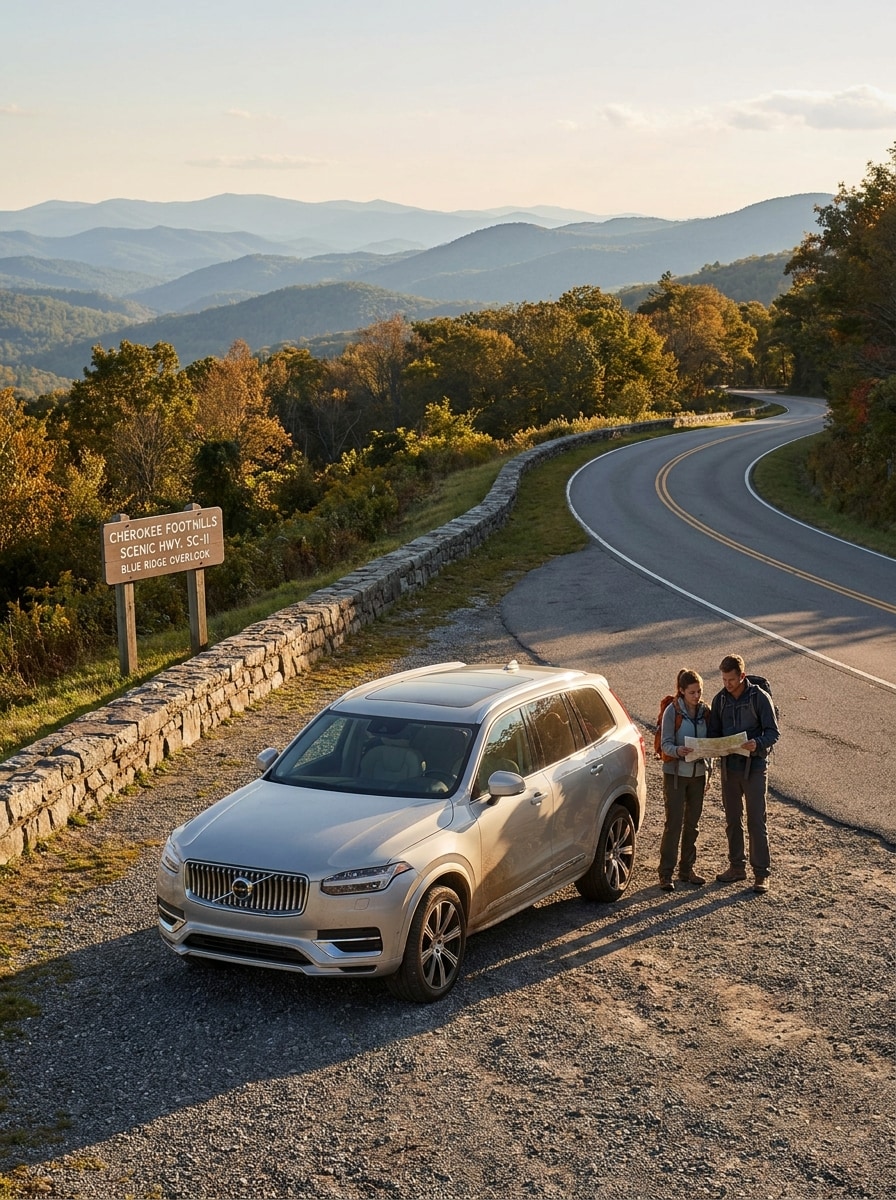
Late August in the Upstate is when the Blue Ridge runs start calling. The humidity breaks, the foothills light up, and the stretch of SC-11 between Gaffney and Walhalla turns into one of the quietly satisfying drives in the Southeast. Buyers walk into our store right around now with the same plan, find a used Volvo XC90, make it theirs before the leaves turn, and avoid discovering three months later that they bought the wrong model year.
Helping with that last part is what we do. The XC90's second generation (2016 to present) spans nearly a decade, and the ownership experience across those years isn't uniform. Some years are genuinely excellent. One in particular shows up again and again in the NHTSA complaint database. Our team weighs a few things before anything else, and you should too.
Browse our current pre-owned Volvo inventory
The short version
- Sweet spot years: 2019, 2020, and 2021 offer the best balance of refined infotainment, lower complaint counts, and real-world durability for a used buyer.
- Years to approach carefully: 2016 carries 9 NHTSA recalls and a documented engine oil consumption pattern; 2017 improved but shares several of the same early-platform issues.
- Confirmed positives in 2019-2021: Faster Sensus infotainment processing, resolved first-year SPA platform gremlins, and NHTSA complaint totals well below the 2016 peak.
- T8 plug-in note: The Recharge T8 trim is available from 2021 onward in the used market at meaningful depreciation; its EPA-verified 32-mile electric range is genuinely useful for daily Greenville driving before you ever touch the gas engine.
- Always verify the VIN on NHTSA.gov for open recalls before signing anything. Recalls are resolved free at any Volvo retailer, but you need to know they exist first.
Which Years Are the Sweet Spot for a Used XC90?
For the second-generation XC90, the sweet spot is tighter than most used-car guides admit, landing on the 2019, 2020, and 2021 model years, the point where Volvo had worked through the early SPA-platform growing pains and hadn't yet introduced the 2022's elevated complaint count. Three clean years in a row. Not a bad run for a three-row.
| Year Range | Sweet Spot? | Years to Watch | Why It Matters |
|---|---|---|---|
| 2016 | Skip | Yes | 9 NHTSA recalls, 297 owner complaints; highest complaint count of any XC90 model year; documented engine oil consumption issues |
| 2017 | Caution | Yes | Improved over 2016 but shares the seat belt buckle recall (NHTSA 120797) and several early-platform electrical issues |
| 2018 | Acceptable | Minor | Meaningfully cleaner than 2016-2017; verify recall completion; still some Sensus infotainment complaints |
| 2019 | Sweet Spot | No | Faster infotainment, lower complaint rate, forum consensus positive; low-pressure fuel pump recall (NHTSA-tracked) resolved at dealer |
| 2020 | Sweet Spot | No | Refreshed standard features, strong owner satisfaction, continued complaint-rate improvement |
| 2021 | Sweet Spot | No | Per NHTSA data, 5 recalls and just 17 owner complaints total; the cleanest complaint profile in the second-gen range |
| 2022 | Caution | Yes | Elevated complaint count (64 NHTSA complaints) and 6 recalls for this model year; worth careful VIN check |
| 2023-2024 | Good | Minor | Complaint rate trending down again; rearview camera software recall (NHTSA R10333) affects some units; easily verified by VIN |
The 2021 stands out in our view not for any single feature upgrade but for what the data shows. Per NHTSA complaint records, that model year logged just 17 owner complaints total, with 5 associated recalls. For a luxury three-row SUV that's been in continuous production, that reads as a quiet year in the best possible sense.
The 2019 and 2020 are the practical sweet spots for a lot of buyers because they've depreciated enough to represent real value while still delivering the updated Sensus infotainment processing that made a noticeable difference over the sluggish early-gen system.
See available XC90 models at Volvo Cars Greenville
Which Years Should You Watch Out For?
The 2016 XC90 is the year we're most cautious about, and the numbers explain why, since it carried the highest NHTSA complaint volume of any model year in the second generation, with 297 owner complaints and 9 recall campaigns on file. Engine oil consumption was a recurring documented complaint, and several separate safety-related recalls were issued covering the Side Impact Protection System wiring harness (NHTSA 15V342), a coolant bleeder hose prone to cracking in heat and humidity (NHTSA 19V308, which can cause a fire risk if coolant reaches the catalytic converter heat shield), and a seat belt buckle stud that could loosen and separate from the bracket on 2016-2017 models (NHTSA campaign 120797).
None of that is exotic for a first-year platform. Early model years of a new architecture tend to carry the scars.
That last one is worth saying plainly. A seat belt buckle that can separate from its bracket is not a nuisance recall. It's a safety item, full stop.
Now, the bounded take. A 2016 XC90 with documented recall completion and a clean service history isn't automatically a money pit. Many of these recalls were resolved years ago under Volvo's free-of-charge remedy program, and a well-maintained example can still deliver real Volvo comfort and capability. But you're taking on verification work that the 2019-2021 buyer simply doesn't face, and for a lot of Greenville buyers that tradeoff isn't worth the depreciation discount.
The 2017 at a glance: It improved meaningfully over 2016, but three things still give us pause:
- It shares the seat belt buckle recall (NHTSA 120797) with the 2016.
- Several early-platform electrical concerns carried over from the first model year.
- We'd still recommend a thorough pre-purchase inspection and VIN check before committing. It's not in the same category as 2016, but it's not clean either.
The 2022 deserves a mention. Per NHTSA data, it logged 64 owner complaints and 6 recalls, a spike relative to the 2021. The most common areas were electrical and visibility systems. The 2022 isn't in "avoid" territory the way 2016 is, but it warrants the same careful VIN verification you'd apply to a 2017.
Explore the XC90 plug-in hybrid Recharge lineup
Our team's practical checkpoint: Pull the VIN on NHTSA.gov before any used XC90 purchase. It takes two minutes and tells you exactly which recalls are open on that specific vehicle. A Volvo retailer resolves open recalls at no charge regardless of your ownership status. Don't skip this on a 2016 or 2017, and don't lean on a Carfax alone. NHTSA's database is the primary source.
Which Year XC90 Is Right for Which Buyer?
Matching the right XC90 year to the right driver comes down to how you'll actually use it around the Upstate, whether that's family road trips on SC-11, a value-focused daily driver, a plug-in commuter, or something close to new at a used price. Each one points to a different year. Here's how we'd sort it.
The SC-11 and Blue Ridge buyer (family, road-trip focus): You want a 2020 or 2021. Both deliver the full second-generation XC90 comfort package, Pilot Assist semi-autonomous capability for the long I-85 hauls, and the clean complaint profile that lets you enjoy the drive instead of managing deferred maintenance. The seven-passenger configuration handles a full family without the cargo compromise, though the third row folds flat easier if you slide the second-row seat forward first to clear the release strap. That end-of-summer stretch, when the fall mountain weekends start looking real, is exactly when this configuration makes the most sense.
The value-conscious buyer who can do homework: The 2019 makes a strong case. You'll find it at a meaningful discount relative to 2021, the infotainment system runs on the faster processor that arrived in the 2019 refresh, and the forum consensus is positive. Budget for a pre-purchase inspection at a Volvo specialist, verify open recalls by VIN, and you're into a solid platform, growing pains behind it.
The Recharge T8 buyer: If you're interested in the plug-in hybrid XC90, the 2021 Recharge T8 is the earliest used example where we'd feel comfortable recommending the platform without significant caveats. The EPA rates the current 2026 XC90 T8 at 32 miles of all-electric range. Used 2021 T8 models will have some battery aging by now, but real-world electric-range figures in the 25-28 mile range remain meaningful for Greenville commuters driving to downtown or Pelham Road and back without touching gas. One caveat. Plug-in hybrid maintenance requires strict adherence to Volvo's specialized service intervals, so verify that history carefully.
The buyer who wants near-new reliability at a used price: The 2023 or 2024 is your play. Complaint rates trended back down after the 2022 blip, the rearview camera software recall (affecting some 2023 units, NHTSA R10333) is a simple over-the-air or dealer fix, and you're getting the mature second-generation platform at a real depreciation discount from new.
Learn about financing options at Volvo Cars Greenville
Find Out What Your Current Vehicle Is Worth
Check the maintenance math before the depreciation discount wins you over. The XC90 isn't the maintenance-free ownership experience that a basic compact crossover can be. Per independent repair data, annual maintenance and repair costs run moderate for a luxury SUV in its class. The tradeoff buys you the Scandinavian build quality, the Pilot Assist, the bowed-pine cabin materials, and the safety architecture that makes this a Volvo. Budget for it. A well-maintained XC90 from the right model year earns that commitment back in longevity and genuine driving calm.
There's a reason our team drives these things on SC-11 between Landrum and Walhalla when we get the chance. August is almost gone. The mountains are still right there.
Frequently Asked Questions
What is the best used Volvo XC90 model year to buy?
The 2019, 2020, and 2021 model years represent the clearest sweet spot in the second-generation XC90 lineup. All three benefit from resolved early-platform issues, faster infotainment processing, and notably lower NHTSA complaint rates compared to the 2016-2017 launch years. The 2021 is particularly clean, with just 17 NHTSA owner complaints and 5 recalls on record. For buyers who want strong value with lower per-year depreciation, the 2019 is also a compelling choice.
Which Volvo XC90 years should I avoid?
The 2016 model year is the one to approach with the most caution. It carries 9 NHTSA recall campaigns and 297 owner complaints, the highest figure of any second-generation XC90 year. Documented issues include engine oil consumption, a coolant bleeder hose prone to cracking in heat (NHTSA 19V308), and a seat belt buckle stud that could separate from its bracket on 2016-2017 models (NHTSA 120797). The 2017 improved but shares several of those early-platform concerns. The 2022 also saw an elevated complaint count relative to surrounding years and merits careful VIN verification.
Is the Volvo XC90 T8 Recharge plug-in hybrid worth buying used?
It depends heavily on service history and model year. We'd recommend the 2021 Recharge T8 or newer as the starting point for a used plug-in XC90. The current 2026 XC90 T8 carries an EPA-verified 32-mile all-electric range; a 2021 with normal battery aging will deliver somewhat less, but the daily electric commute benefit remains real for most Greenville drivers. The plug-in hybrid powertrain requires strict adherence to Volvo's specialized maintenance schedule, so verified service records are non-negotiable on any used T8 purchase.
Categories:
Social