
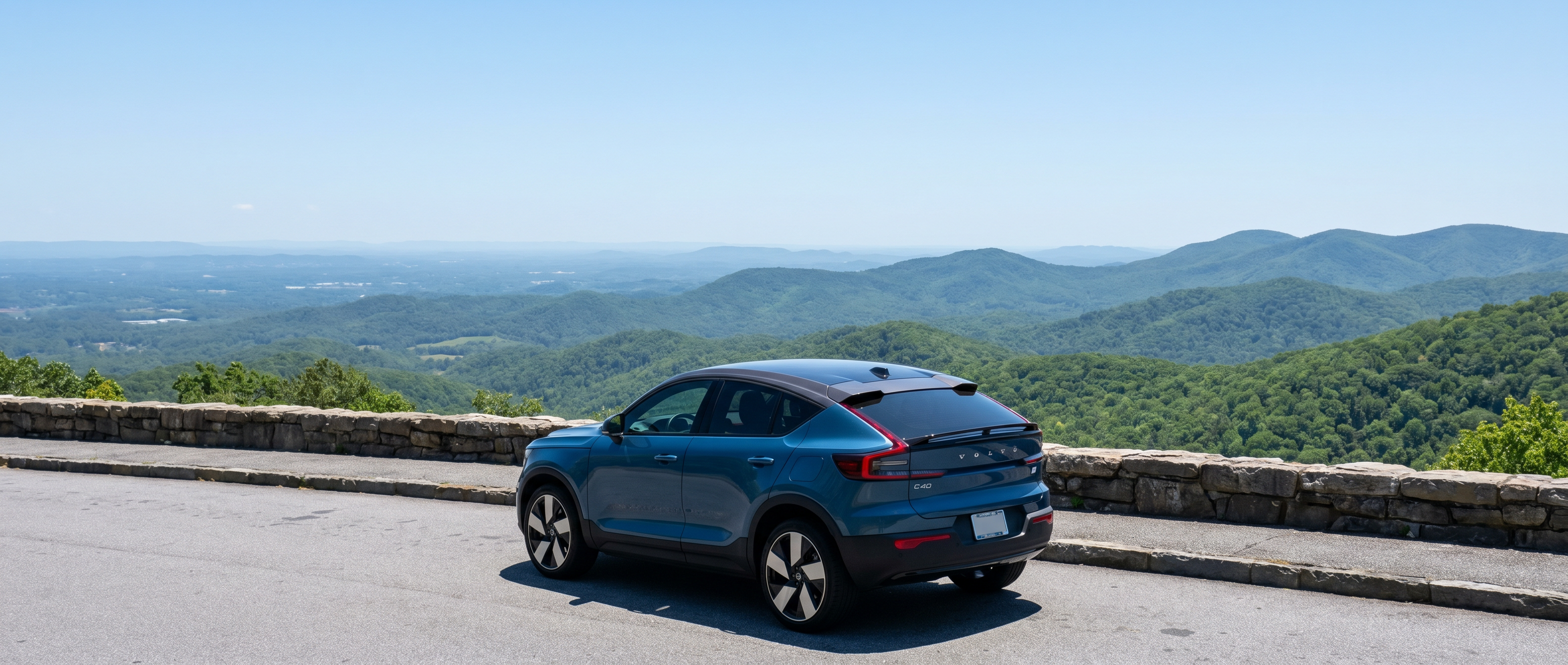
A summer road trip in the C40 Recharge is genuinely comfortable -- once you accept that the preparation happens at home, not at a gas pump. Complete this checklist the night before and the morning of your departure, and the drive takes care of itself.
Browse the current Volvo Recharge lineup at Volvo Cars Greenville
What Goes on the Checklist?
The twelve items below cover the four categories that matter most for a warm-weather long-distance drive in an all-electric vehicle: power management, cabin comfort, route intelligence, and cargo. Work through them in order -- the sequence is deliberate.
- [ ] Set charge limit to 90% for departure day. Volvo recommends a daily charge ceiling of 80% to protect the battery, but on a road-trip departure day, 90% gives you a meaningful buffer. The key: start driving promptly after it reaches that level rather than letting the pack sit at full capacity in July heat.
- [ ] Precondition the cabin while still plugged in. This is the C40's single most underused feature. Activate climate control through the Volvo Cars app before you unplug so that the A/C energy comes from your home circuit, not the battery. On a 95-degree Upstate South Carolina afternoon, this alone preserves meaningful range on the first leg.
- [ ] Route to your first charging stop via Google Maps in the car. The C40 Recharge runs Google built-in natively, which means Google Maps on the center display with EV-aware routing that shows your battery level on arrival at the destination and at intermediate stops. Enter the charger as a waypoint, not just the final destination, so the car can calculate state of charge accurately.
- [ ] Enable battery preconditioning before each DC fast charge stop. When you navigate to a fast charger through the in-car Google Maps, the C40 automatically warms or cools the battery to its optimal charging temperature before you arrive. This step alone can shave several minutes off a 10-to-80% charge session at a high-power station.
- [ ] Plan legs of 150 to 210 miles, not maximum range. The EPA rates the C40 Recharge Single Motor at 297 miles, but highway speeds and summer A/C in Greenville's 90-plus-degree June-through-September weather reduce real-world range. A planning leg of 150 to 210 miles between charging stops keeps you well clear of any range anxiety and arrives at the charger with a warm, fast-charging battery.
- [ ] Identify your primary DC fast charger and one backup for each stop. Along I-85, DC fast chargers serve the corridor at key exits between Greenville and Atlanta. Along I-26, coverage runs through the Columbia area for the Charleston run. Use PlugShare, the Volvo Cars app, or Google Maps (in-car) to confirm station status the morning you leave, and note a fallback Level 2 site within 15 miles of each primary stop.
- [ ] Add the NACS Fast Charging Adapter to your kit if your car carries one. Volvo lists access to more than 17,800 additional DC fast chargers through the Tesla Supercharger network via a NACS adapter available through the retailer. That dramatically broadens your options along I-85 and I-26, where the Supercharger footprint is substantial.
- [ ] Set the cabin temperature to 72 degrees rather than 68. A small adjustment with a real effect: the lower you push the cabin setpoint against a 95-degree ambient, the harder the compressor works and the more range it takes. Most drivers find 72 degrees entirely comfortable in the C40's well-insulated cabin.
- [ ] Check tire pressure before departure. Properly inflated tires contribute meaningfully to highway efficiency. The C40 ships on low-rolling-resistance tires calibrated for range; do not let summer heat mask an underinflated tire by making the ride feel normal.
- [ ] Arrive at each fast charger between 10% and 20%, target 70% to 80% to depart. The C40's charging curve is strongest between roughly 20% and 70%, where the pack accepts the highest sustained power. Charging past 80% at a DC fast station slows significantly, so unplugging around 70 to 80% and driving to the next stop is nearly always faster than waiting for the last portion of the charge.
- [ ] Pack the Level 1 portable cord. For overnight stops at hotels without dedicated EV chargers, a plain 120-volt outlet adds roughly 4 to 5 miles of range per hour -- enough to top up 40 to 50 miles overnight, which can meaningfully change your next-morning plan.
- [ ] Verify the service record is current before a long trip. Brake fluid, tire condition, and software version all matter more on a 400-mile drive than a 40-mile commute. If your C40 is due for a check, schedule it a week before departure.
See Current Volvo Recharge Offers
Why Each Step Earns Its Place
The checklist above is not cautionary padding. Every item addresses a real variable that changes your experience on a hot South Carolina day.
Preconditioning and charge limit together solve the most common road-trip frustration. Greenville regularly sees 90-degree-plus temperatures from June through September. Lithium-ion packs perform best between 60 and 80 degrees -- well below a July afternoon here. When the battery is hot, thermal management draws power to cool it, and the cabin's A/C draws more on top of that. Preconditioning while plugged in removes both draws from the battery for the first 20 to 30 miles of your drive, which is typically the hottest part of the day.
The Google built-in advantage is genuinely different from a phone mount. The C40 Recharge's native Google Maps integration means the system knows the car's current state of charge, calculates consumption at your speed and elevation, and displays remaining range at the destination in real time. The XC40 Recharge shares this platform, but among compact electric crossovers the C40's low drag coefficient and rearward weight distribution make it slightly more efficient at sustained highway speeds -- meaning the routing predictions tend to track closely with what you actually experience.
Leg length is the underrated variable. Owners who treat the EPA 297-mile figure as a planning number end up arriving at chargers with less buffer than expected. Planning around 150 to 210 miles per leg -- roughly two and a half to three hours of driving -- keeps the pack warm for fast charging, aligns naturally with a genuine rest stop, and leaves a margin for slower sections or construction on I-85 or I-26. View available C40 Recharge inventory at Volvo Cars Greenville to confirm whether your car carries the Single Motor Extended Range powertrain (which offers the EPA 297-mile figure) or the Twin Motor AWD (EPA-rated at 257 miles) -- the planning rhythm differs slightly between the two.
Tip: For the run along SC-11, the Cherokee Foothills National Scenic Highway, plan to leave Greenville with a full charge and count on regenerative braking on the descents to recover a modest amount of range. The route's elevation changes are real, but the return trip's downhill sections work in your favor, and neither direction requires an en-route charge from a full departure.
Why These Items Matter on the Road
| Checklist Item | Why It Matters in Upstate SC Summer |
|---|---|
| Precondition cabin while plugged in | Offloads A/C energy demand from the battery on the hottest part of the drive |
| Set charge limit to 90% on departure day | Balances maximum range with battery protection in sustained summer heat |
| Navigate charger through in-car Google Maps | Activates automatic battery preconditioning before each DC fast charge stop |
| Plan 150-to-210-mile legs | Keeps the pack in its fastest-charging window; aligns with natural rest breaks |
| Arrive at charger at 10-20%, depart at 70-80% | Stays in the C40's strongest charging curve; avoids slow top-of-charge taper |
| Set cabin to 72 degrees, not 68 | Reduces compressor load meaningfully without sacrificing comfort |
| Carry Level 1 cord | Provides overnight top-up at hotels without dedicated EV infrastructure |
| Confirm tire pressure at home | Low-rolling-resistance tires recoup highway efficiency quietly but consistently |
The Volvo EX90 brings a larger battery and longer range for families planning multi-day trips with more passengers -- worth considering if your summer plans extend well beyond a weekend.
Your Print-and-Go Recap
The night before, set the charge limit, confirm your first charger stop and its backup in Google Maps or PlugShare, and make sure the portable Level 1 cord is in the frunk. The morning of, precondition the cabin while still plugged in, confirm tire pressure, and set the cabin temperature before you pull out of the driveway. On the road, navigate to each charger as a waypoint through the C40's in-car Google Maps so the preconditioning triggers automatically, arrive between 10% and 20%, and depart between 70% and 80%. That rhythm -- consistent legs, planned stops, one backup identified -- is what makes a C40 Recharge summer road trip from Greenville feel unhurried and deliberate rather than improvised.
If your C40 is due for a pre-trip service check, schedule an appointment with the Volvo Cars Greenville service team at your convenience before you head out.
Frequently Asked Questions
How much does summer heat actually reduce the C40 Recharge's range?
South Carolina summer heat affects the C40 Recharge's real-world range in two ways. The battery's thermal management system works to keep the pack within its optimal temperature window, which consumes power. The cabin's air conditioning adds a second simultaneous draw. Together, on a 90-plus-degree day at highway speed, expect a noticeable reduction from the EPA figures -- the EPA rates the Single Motor at 297 miles under controlled conditions, but real-world summer highway driving in Upstate SC typically puts practical leg planning closer to 150 to 210 miles per charge. Preconditioning the cabin while still plugged in at home removes the A/C draw from the battery for the first portion of the drive and is the most effective single step for recovering warm-weather range.
Can I reach Atlanta or Charlotte from Greenville in the C40 Recharge without stopping to charge?
The Atlanta run on I-85 is roughly 145 miles from Greenville -- comfortably within the C40 Recharge's practical summer range in a single charge, assuming a near-full departure and moderate highway speeds. Charlotte via I-85 is approximately 90 miles, an easy one-shot trip in any C40 configuration. For longer legs -- say, Charleston via I-26 at roughly 215 miles -- one DC fast-charge stop near the Columbia area brings you in with a comfortable buffer. The key is departing at 90% or above and navigating the intermediate charger as a waypoint through the in-car Google Maps so the car preconditions the battery before you arrive at the station.
Categories:
Social