
You set your tires correctly last month. Now you step outside on a July morning, glance at the dashboard after a short drive, and something feels slightly off -- the ride is a touch harsher, the steering feels crisper than usual, and by afternoon you notice your TPMS light has stayed dark the entire time. Everything looks fine. It probably is not.
Hot Upstate SC summers do something predictable to tire pressure: they raise it. The issue most drivers miss is that their Volvo's Tire Pressure Monitoring System is not designed to catch overinflation. Understanding what actually happens inside your tires on an 89-degree Greenville day -- and what to do about it before you head onto I-85 or SC-11 -- is the one adjustment that separates a routine summer from a roadside emergency.
Schedule a tire pressure check with our service team before your next road trip.
What Is Actually Going On Inside a Hot Tire?
The physics behind summer tire pressure is straightforward, and knowing the numbers makes the behavior predictable rather than alarming.
| Symptom / Situation | Likely Cause | What to Do |
|---|---|---|
| Tires read 4-7 PSI above placard after driving | Normal heat expansion from ambient temp + road friction | Do not bleed air; this is expected |
| TPMS light off but ride feels harsh / center tread wearing faster | Overinflation from heat -- TPMS does not alert for this | Check cold PSI against door-jamb placard |
| TPMS light on in the morning, off by midday | Marginal low pressure masked by heat as tires warm up | Check all four cold; slow leak possible |
| TPMS light stays on after driving begins | Genuine underinflation or sensor fault | Pull over; check pressure; visit service |
| Tires look visually fine but gauge reads low | Modern radial tires can look normal 10 PSI low | Always use a gauge; visual checks are unreliable |
Per NHTSA's TireWise guidance, tire pressure rises approximately 1 PSI for every 10 degrees Fahrenheit increase in temperature. Greenville's July average high sits at 89 degrees Fahrenheit, and the swing between an early-morning cool garage (say, 70 degrees) and peak afternoon on a sun-soaked I-85 on-ramp can easily span 20 to 30 degrees of ambient difference -- before friction adds more. That alone can push a correctly set tire 2 to 3 PSI above its placard target before a mile of highway driving stacks on further heat.
The pavement tells the deeper story. Black asphalt under direct summer sun regularly reaches surface temperatures of 130 to 160 degrees Fahrenheit -- even when the air temperature is "only" 90 degrees. Every stop at a Greenville intersection is a heat-soak event, not just a traffic delay.
The Volvo XC60 and the Volvo XC90 both display live tire pressure readings through their center screens, which is genuinely useful -- but those readings reflect hot, in-motion pressure. They are not a substitute for a cold morning check against the number on your door jamb.
The Common Cause: Checking Pressure at the Wrong Time
The most widespread tire pressure mistake Upstate SC drivers make is not ignoring their tires -- it is checking them at the wrong moment.
NHTSA defines "cold" tire pressure as pressure measured when the vehicle has not been driven for at least three hours, or has been driven fewer than one mile at low speed. If you stop for gas on a long I-85 run and check your pressure two hours into the drive, you are reading hot inflation pressure. On a Greenville summer afternoon, that reading will be 4 to 8 PSI higher than the cold baseline the placard specifies. If you then bleed air to match the placard number, your tires will be significantly underinflated once they cool overnight.
According to NHTSA, underinflation is the leading cause of tire failure. NHTSA also estimates that approximately one in four vehicles on U.S. roads is driving on at least one significantly underinflated tire at any given time. And per NHTSA's TireWise program, only about 19 percent of consumers properly inflate their tires -- the most common error being using the maximum pressure number molded into the tire sidewall rather than the vehicle manufacturer's placard figure.
For Volvo drivers in Greenville, that placard is on the driver-side B-pillar between the front and rear doors. Volvo also makes it easy to find in the center display. The number there -- not the sidewall, not your neighbor's advice -- is the verified cold inflation target for your specific model, trim, and wheel size.
A note on the TPMS light: Your Volvo's TPMS is required by federal regulation (on all vehicles from the 2008 model year onward) to alert you when pressure drops to 25 percent below the placard -- which for a 35 PSI tire means the warning activates around 26 PSI. That is already well into the damage zone. The system also does not warn you about overinflation from summer heat. It is a backup safety net, not a daily pressure gauge. Treat it accordingly.
Next step: Before your next lake weekend at Lake Hartwell or a drive on SC-11 through the Cherokee Foothills, spend five minutes checking all four tires cold, in the morning, with a quality digital gauge. That single habit is what NHTSA and Volvo both recommend.
DIY Check vs. Having the Service Team Handle It
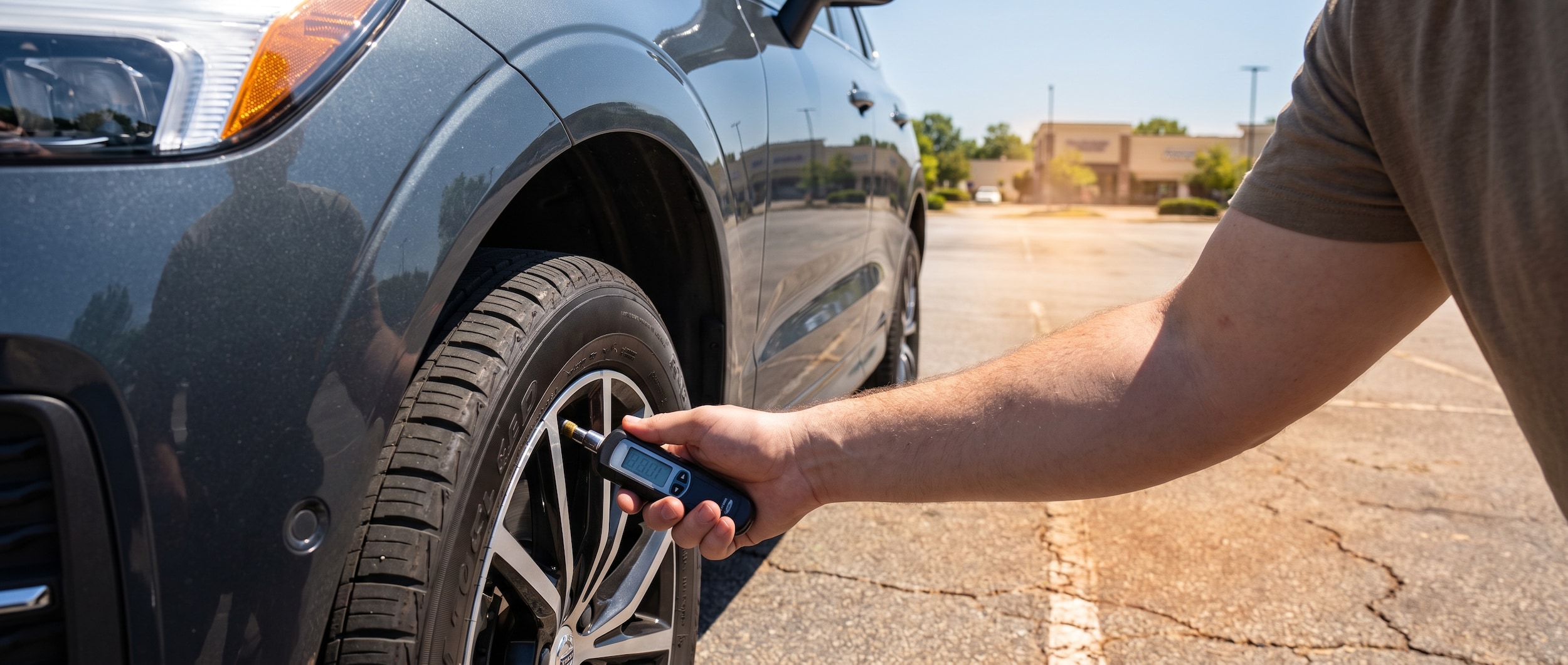
Most drivers can manage their own tire pressure with a quality digital gauge and two minutes before the morning commute. Here is when to do it yourself, and when it makes more sense to have a technician look.
Handle it yourself when:
- You are checking pressure as part of a regular monthly habit or before a road trip
- Pressure on all four tires reads within 2 PSI of the door-jamb placard, cold
- The TPMS light came on overnight and went off after a short morning drive (likely marginal pressure that heat corrected -- still worth a gauge check to confirm)
See the service team when:
- One tire consistently reads 3 or more PSI below the others on cold checks
- The TPMS light stays on after several miles of driving -- this can indicate a slow leak, a faulty sensor, or a valve stem issue
- You notice center-tread wear on any tire (sign of sustained overinflation)
- Any tire shows sidewall bulging, cracking along the sidewall, or an embedded object
A quick note on tire age that many owners overlook: NHTSA notes that some vehicle manufacturers recommend tire replacement at six years from the DOT date code on the sidewall, regardless of tread depth. Rubber degrades from UV and heat exposure, becoming more brittle and prone to cracking under summer stress. If your tires are approaching that range, a summer road trip through the Blue Ridge on SC-11 is exactly the kind of sustained-speed, hot-pavement run that can expose aged rubber. Our service team can read the DOT code for you and advise on condition.
XC90 Recharge owners in particular should note that Recharge models carry added battery weight that can affect the front-rear pressure split -- always confirm front and rear targets separately on the door-jamb placard, as they may differ.
Frequently Asked Questions
Should I let air out of my Volvo tires when they read high in summer heat?
Not unless the tires are cold. A reading that is 4 to 8 PSI above the door-jamb placard after driving or after sitting in the sun is normal heat expansion -- that is physics, not a fault. If you bleed air from a hot tire to match the placard, the pressure will drop further as the tire cools overnight, leaving you underinflated when you start the next morning. Always wait until tires are cold (parked at least three hours, not in direct sun) before making any pressure adjustments. The one exception: if a cold-confirmed reading is already significantly above placard, release air in small bursts, then recheck cold.
Does my Volvo's TPMS light mean my tire pressure is fine if it is not on?
No. The TPMS warning light activates when pressure drops to roughly 25 percent below the placard -- for a 35 PSI tire that is around 26 PSI, already well into unsafe territory. More importantly, TPMS does not alert for overinflation from summer heat. A tire that started the summer properly inflated and has been riding 4 to 5 PSI high due to heat and friction will show no warning light at all. Monthly cold-morning checks with a quality gauge remain the only reliable way to confirm your Volvo's tires are within the recommended range.
Categories:
Social