
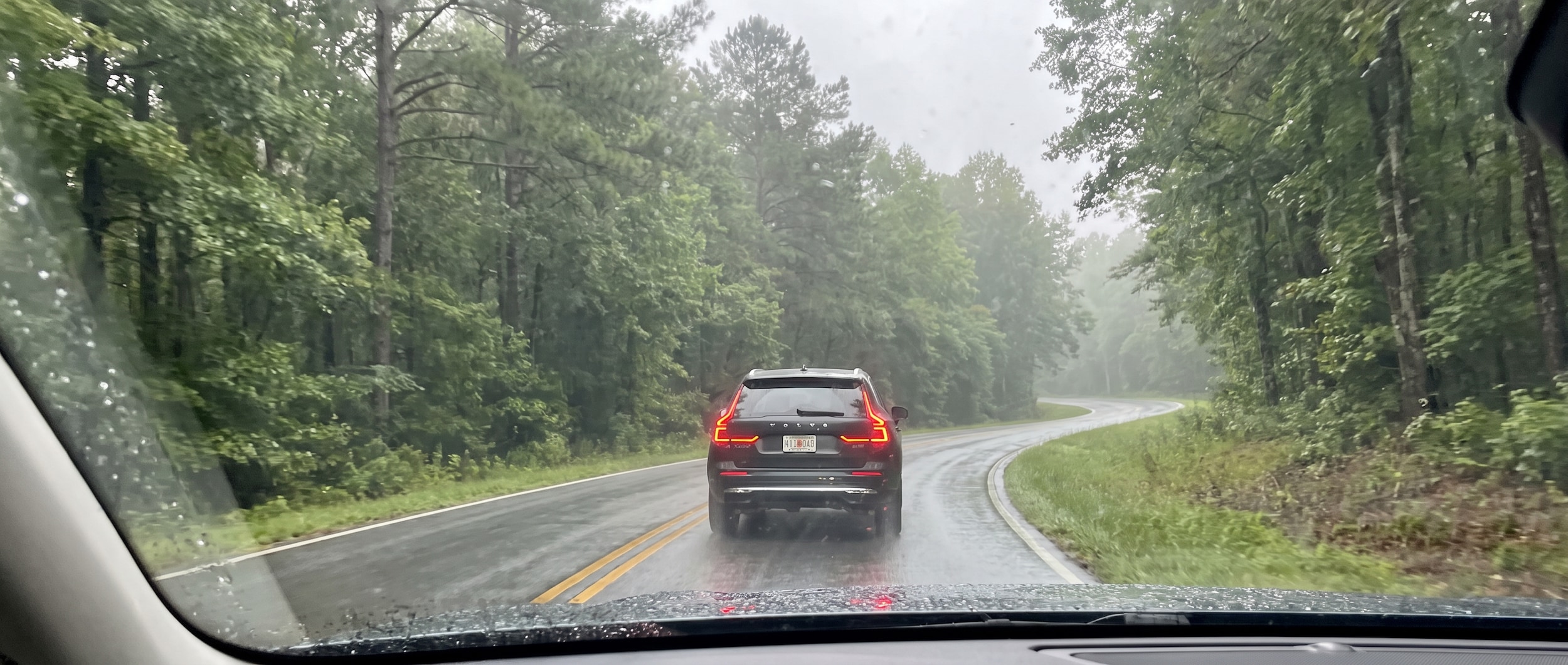
Volvo has built safety architecture into every car it makes, and Electronic Stability Control sits at the center of all of it. The bottom line up front: ESC on a Volvo isn't a single feature you can point to on a spec sheet. It's a layered architecture of four distinct subfunctions running simultaneously, and understanding what each one does will change the way you read the car's behavior. That distinction matters more here in Greenville than the brochure ever tells you.
The Volvo XC90 carries all four of these subfunctions standard from the base trim. So does every other model in the current lineup.
What Do You Actually Get at Each Layer of the System?
Volvo calls the full system DSTC: Dynamic Stability and Traction Control (their branded name for ESC), and it runs four separate jobs at once. Per Volvo's own support documentation, the stability and traction control system cannot be switched off entirely. That surprises drivers who assume they can toggle everything away in Sport mode. They can't. What varies is how aggressively the system allows deviation before it intervenes.
| DSTC Subfunction | What It Actually Does | When You Feel It | Who It Matters Most To |
|---|---|---|---|
| Active Yaw Control (AYC) | Brakes individual wheels to maintain directional stability if the car starts sliding laterally in a corner | A brief, firm pulse through the pedal mid-corner | Anyone driving twisting mountain roads or wet highway exits |
| Traction Control (TC) | Transfers power from a slipping drive wheel to the opposite wheel on the same axle | Reduced throttle response at low speed on wet pavement | Drivers who pull out of parking lots or driveways in rain |
| Spin Control (SC) | Prevents drive wheels from spinning during acceleration | The car feels like it's holding back power from a dead stop | Anyone who notices sluggish launch on a gravel shoulder or wet on-ramp |
| Engine Drag Control (EDC) | Prevents wheel lockup during engine braking in low gears | Steadier deceleration when downshifting on a descent | Drivers who engine-brake on hills rather than riding the brakes |
Each of those is a permanent function. AYC and Traction Control cannot be switched off. Spin Control can be temporarily disabled in situations like deep sand or snow, but it resets every time you restart the engine.
The Four Subfunctions Working Together
AYC does the dramatic work: when the yaw rate sensor detects the rear stepping out in a corner, it applies braking force to a specific wheel to rotate the car back toward the driver's intended line. Per NHTSA research, ESC systems using individual-wheel braking reduce single-vehicle SUV crashes by an estimated 59%. That figure covers exactly the kind of situation AYC handles, where the driver misjudges a curve or overcorrects and the car starts moving somewhere other than where the wheel is pointed.
Traction Control handles the subtler problem. At low speeds, when one drive wheel finds wet asphalt and the other finds a dry patch, TC quietly shifts power to the wheel that still has grip. You may never consciously notice it working. What you will notice is that the car pulls cleanly away from a stoplight in the rain without fishtailing, and there's a meaningful difference between those two experiences.
The XC60 Recharge plug-in hybrid adds a layer of complexity here; the electric motor's instant torque delivery can outrun traction faster than a conventional powertrain. The stability system is calibrated for that behavior. Spin Control and TC both work harder and faster in the Recharge variants than in a standard mild-hybrid configuration.
EDC is the one most drivers have never heard of. When you're descending a grade in a low gear and lift off the throttle, engine compression slows the drive wheels. If that braking force exceeds the available traction, the wheels can lock before you touch the brake pedal. EDC measures for exactly that condition and modulates engine output to keep the wheels rolling freely. The V60 Cross Country (which sees more than its share of mountain weekend use from Greenville owners) benefits from EDC on every downhill approach. The system runs without requiring any driver input.
Note: The pulsing or throbbing sound you may hear through the brake pedal during ESC intervention is normal and expected. Volvo's own documentation describes it as a byproduct of the system applying and releasing brake pressure rapidly. It's confirmation the system is working, not a sign of a fault.
Per NHTSA, ESC reduces single-vehicle SUV crashes by an estimated 59% on a Volvo. That figure is backed by four named subfunctions operating simultaneously, not a single switch.
What ESC Feels Like in the Real World (and Where Its Limits Are)
Worth being direct about the tradeoff: ESC is not a speed permit. It doesn't let you carry more speed into a corner than the physics allow. What it does is catch the moment when the car begins losing its intended path and apply a corrective input faster than any driver realistically can. That's meaningful. And it's also not a substitute for appropriate speed.
Summer thunderstorms move fast through the Upstate and can drop heavy rain on I-385 in the space of a mile, which means the road surface goes from dry to standing water between exits. That's exactly the condition where AYC and Traction Control activate with no warning: the car finds less grip than the throttle expects, and the system modulates without you asking it to. You'll feel the pedal pulse and notice a brief hesitation in acceleration. The correction resolves in seconds.
On SC-11, the Cherokee Foothills National Scenic Highway, the curves are longer and more compound than they appear from the pavement. Mid-corner correction, where AYC does its main job, matters more there than on a straight expressway. We notice on cars coming through our service lane that owners who drive SC-11 regularly become attuned to the system's behavior in a way flat-road drivers simply don't. The yaw rate sensor reads the difference between the direction the wheel is pointed and the direction the chassis is actually moving, and it acts on that gap in fractions of a second.
The one limitation worth naming plainly: if you drive into a curve well beyond the available traction, ESC can reduce but cannot eliminate the consequence. On standing water or ice, the system cannot manufacture friction that isn't there. It needs at least some grip to work with.
Browse our current Volvo inventory
The Smart Choice for Greenville Drivers Is Understanding the System Before Needing It
Every Volvo on our lot ships with this system active and unchanged by trim level, which is a deliberate design choice rooted in Volvo's human-centric safety philosophy: the system shouldn't require a driver to opt into something that fundamental. The value isn't in having it listed on a window sticker. Understanding what the system is doing when you feel the wheel pulse or notice the car hold back from a launch is where the value actually lives.
If you drive the foothills, use the interstates in summer storms, or simply want to understand the car you're in, the four subfunctions of DSTC are worth knowing by name. AYC keeps the car pointed where you're steering in a corner. Traction Control keeps traction distributed cleanly at low speed. Spin Control prevents wheelspin from launch. EDC prevents lockup under engine braking. All four run constantly. None of them require you to do anything.
Quiet competence. That's the phrase for it.
Frequently Asked Questions
Can I turn off ESC completely on my Volvo?
No. Volvo's DSTC system cannot be fully deactivated. The core stability subfunctions (Active Yaw Control and Traction Control) are permanent and cannot be switched off. Spin Control can be temporarily disabled in specific situations such as deep sand or snow to allow maximum wheelspin for traction, but it resets automatically every time the engine is restarted. Some older Volvo models offered a Sport mode that allowed a more active driving style with less aggressive intervention, but even that mode preserved the fundamental stability functions.
What does it mean when my Volvo's stability light flashes while I'm driving?
A flashing stability light means the ESC system is actively intervening. The system detected a difference between the direction the wheel is pointed and the direction the chassis is actually moving, and it applied corrective braking or throttle reduction to bring those into alignment. A brief flash during a wet corner or a quick lane change is normal. If the light stays on solid rather than flashing, that typically indicates a system fault. In that case, it's worth having a trained Volvo technician inspect the system before driving in conditions that would normally require it.
What does each subfunction of DSTC do?
Volvo's DSTC system has four subfunctions. Active Yaw Control (AYC) brakes individual wheels to keep the car pointed where you're steering in a corner. Traction Control (TC) shifts power between drive wheels to maintain grip at low speed. Spin Control (SC) prevents wheelspin during acceleration. Engine Drag Control (EDC) prevents wheel lockup during engine braking. All four run constantly without requiring any driver input.
Categories:
Social