
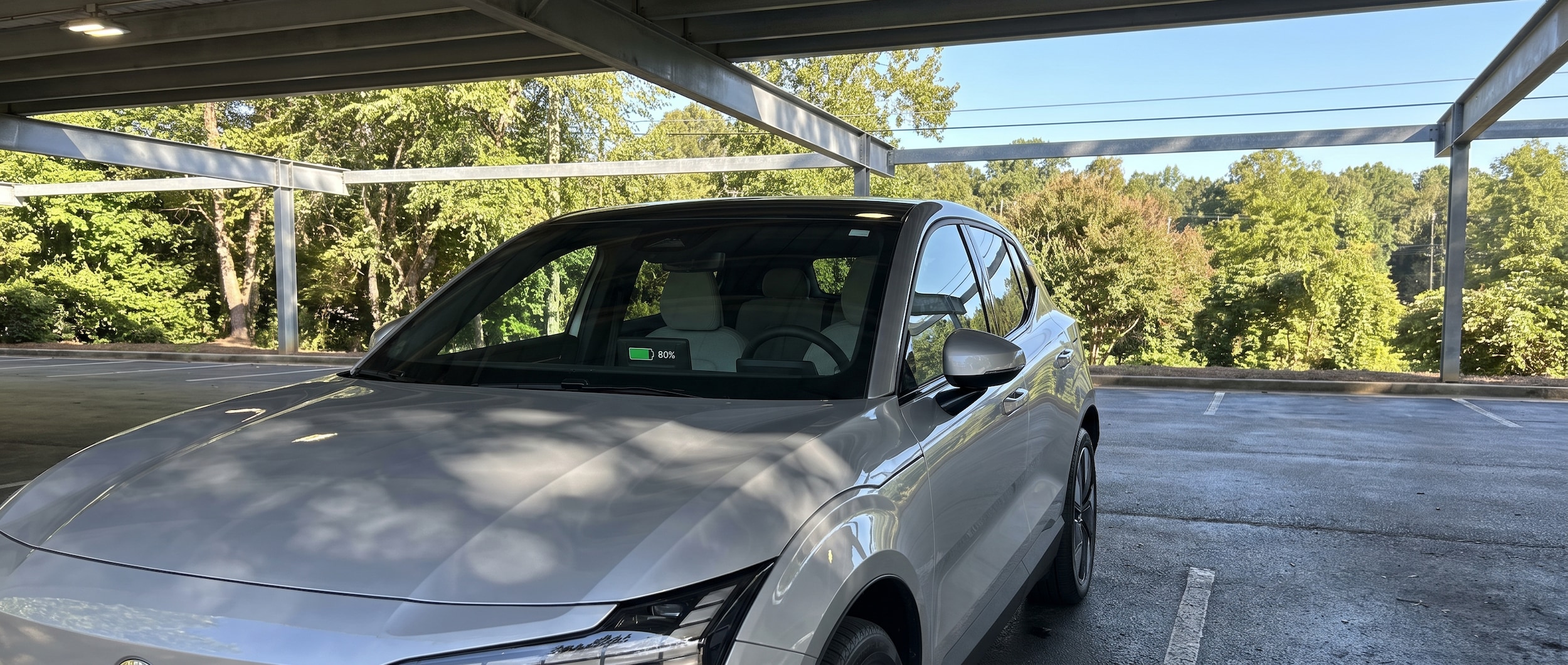
One quick note before we get into it: if you searched "XC40 Recharge," you've landed in the right place. Volvo renamed that vehicle the EX40 starting with the 2025 model year in the US. Same platform, same Scandinavian engineering, new badge. We'll use both names throughout so nothing gets confusing. The Volvo XC40 Recharge lineup at our Greenville store is where you can explore what's currently available.
Greenville's July is not gentle with anything, and a battery pack is no exception. Average highs sit around 90 F, and the heat index climbs to roughly 106 F on a typical afternoon. That's the most thermally demanding season your XC40 Recharge will face all year, and the car's behavior during these months genuinely surprises first-time owners. Here's where we land after working with these cars through Upstate summers: the 2026 EX40 has active liquid thermal management that works hard to protect the battery in heat, and Volvo's own support documentation tells you exactly what to do (and what to avoid) to keep that system working for you rather than against you. Follow the playbook below and you'll protect both your range and your long-term battery health.
Where Should You Park, and What Time Should You Charge?
Timing and location matter more in July than in any other month, and the table below maps the most common Greenville summer scenarios to their battery impact and the right response. Every recommendation traces back to Volvo's published battery management guidance for the XC40 Recharge and EX40.
| Situation | Time of Day | Battery Impact | What to Do |
|---|---|---|---|
| Outdoor lot, full sun | Midday (11am-3pm) | High: thermal system activates, draws battery power to cool the pack | Park in shade or structure; plug in if available |
| Parking garage, shaded | Any | Low: reduced solar load, thermal system works less | Ideal; no action needed beyond normal charging habits |
| Parked, unplugged, above 86 F | Extended (2+ hours) | Moderate-high: car cools battery passively using stored charge | Plug in so the car uses grid power, not battery, to run cooling |
| Charging at a DC fast charger | Midday peak heat | Moderate: heat slows charging speed, adds minor wear | Charge in early morning or evening when ambient temps are lower |
| Overnight home charge (Level 2) | Late evening | Minimal: cooler air reduces thermal load | Ideal window; battery arrives at morning set-point with minimal heat stress |
The threshold that matters most here is 86 F (30 C), the point at which Volvo's support documentation specifically recommends keeping the car plugged in. Greenville regularly clears that mark by mid-morning in July. When the car is plugged in, it runs the battery cooling system on grid power rather than drawing down your state of charge. Come back to a shaded, plugged-in EX40 after a two-hour Downtown Greenville lunch and the battery will be in meaningfully better shape than if you'd left it unplugged in a surface lot. The car is doing the work either way; the only question is whether it's spending your electrons or the grid's.
Managing Range Expectations on Hot Upstate Days
The tradeoff worth naming upfront: heat doesn't hurt the EX40's range the way cold does, but it does introduce real costs. The EPA rates the 2026 EX40 Single Motor at 296 miles and the Twin Motor AWD at 260 miles. Those figures assume controlled conditions. On a 95 F Greenville afternoon, the air conditioning system draws consistent power, and the thermal management system adds a smaller but genuine background load. Real-world summer range will run somewhat below the EPA number, though it stays well above what you'd see in a February cold snap.
The car is built for sustained heat exposure. Volvo's EX30 and the broader Recharge lineup all share active liquid thermal management, not the passive air-cooled approach found in older or lower-cost EVs. The system keeps the battery within its optimal temperature band. Volvo is direct in its documentation: "strong sunlight combined with high temperatures can lead to very high battery temperatures and excessive cooling needs." That language is written for markets like Greenville, not Stockholm. Owners doing longer summer runs on SC-11 Cherokee Foothills National Scenic Highway with the AC running hard have reported range closer to 220-240 miles. Entirely manageable with a little planning.
On the service side, we've noticed a pattern worth flagging. Owners who regularly let the battery sit unplugged in direct sun above 90 F for extended periods tend to see their range estimate drift lower over a season. The physics are straightforward: heat degrades lithium-ion cells faster than any other variable, and the XC40 Recharge/EX40's thermal system is designed to offset that stress when it has grid power available to work with. Give it a plug and a shaded spot, and it does exactly what Volvo engineered it to do.
Schedule a Service Appointment
Insider parking tip: The Greenville parking structures near Falls Park on the Reedy in Downtown Greenville offer covered, multi-level spaces that dramatically reduce the thermal load on a parked EX40. Level 2 chargers are available in some Downtown Greenville structures. Arriving before 10am on a weekend secures both the shade and a charger before the lots fill. If you're plugged in, the car manages its own battery temperature without touching your stored range.
A note on charging etiquette at hot-weather fast chargers: When heat is high, DC fast charging throttles slightly to protect the battery. Don't unplug and replug repeatedly trying to force a higher speed. The car's battery management system is doing exactly what it's designed to do. Pre-conditioning the battery via the Volvo On Call app before you arrive at the charger can bring charging speeds closer to the rated 205 kW maximum.
Your Summer Readiness Checklist Before Every Drive
Print this. Put it on your phone. Use it on any day Greenville is climbing past 88 F.
- [ ] Check the Volvo On Call app: confirm battery state of charge before unplugging
- [ ] Pre-condition the cabin via the app while still plugged in (cools the interior using grid power, not battery)
- [ ] Set charge limit to 80-90% for daily use; reserve 100% for long Upstate trips only
- [ ] Identify a shaded parking spot at your destination before you leave
- [ ] If parking for more than two hours in summer heat, plan to plug in
- [ ] Avoid charging at midday peak heat when a morning or evening window is available
- [ ] Check the Volvo On Call app for battery temp warnings before a DC fast charge session
- [ ] On longer drives (Lake Hartwell, Paris Mountain, the Blue Ridge), plan a charging stop at roughly 20-25% remaining rather than running lower
Go Enjoy the Upstate Summer
The XC40 Recharge and its current EX40 successor are genuinely well-suited to Greenville summers, and we'd say that even if the thermal engineering weren't so clearly thought through. The active liquid management system is intelligent and designed for sustained heat exposure. The limitation worth naming honestly is that it needs a little from you: a shaded spot when possible, a plug when temperatures are elevated, and charging scheduled for the cooler ends of the day.
Plan those three things and the car handles the rest, keeping your EPA-rated range within striking distance all season. Your battery will be in strong shape when the Upstate cools down in October.
Explore our current Volvo EX90 lineup if you're thinking about a larger electric option for the family, and check our new inventory for current EX40 availability. Our team at Volvo Cars Greenville is on Duvall Drive and happy to walk you through the summer ownership experience in person.
Categories:
Social