
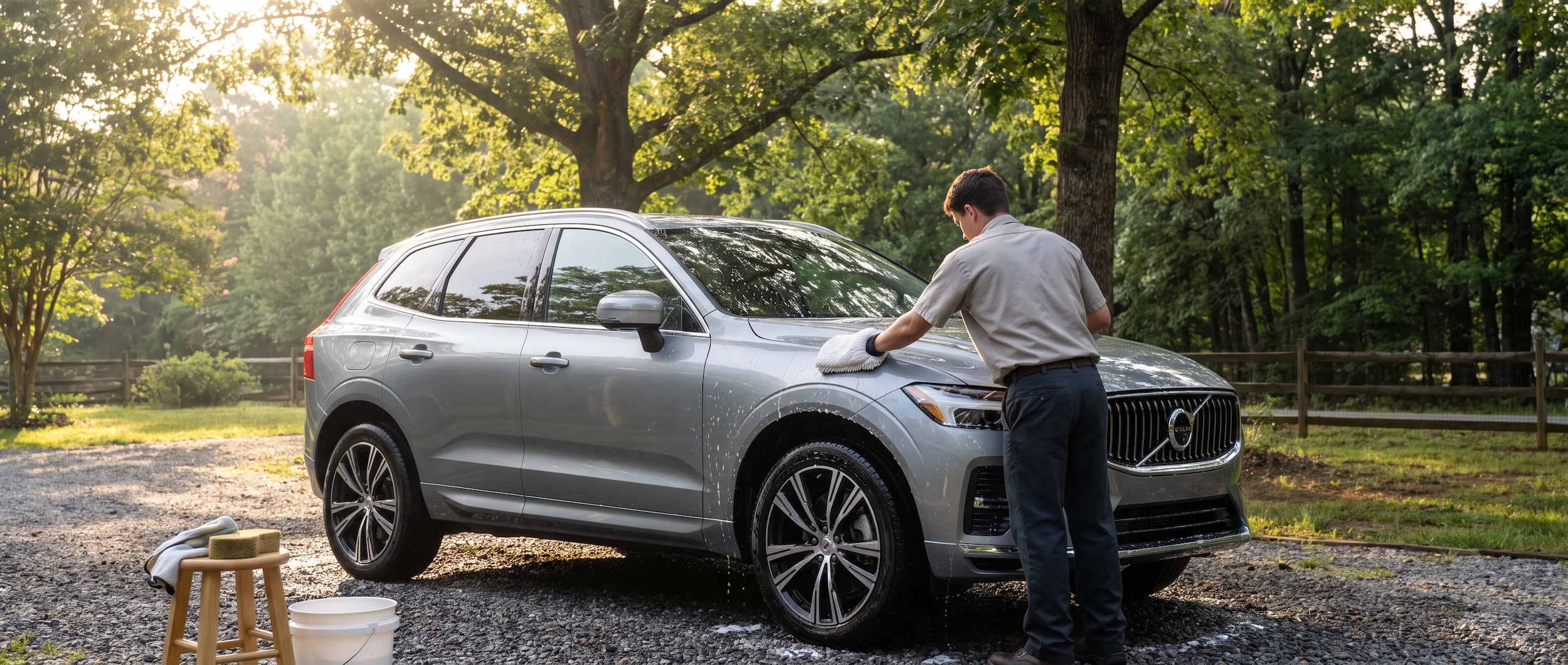
By the Volvo Cars Greenville Team | July 2026
Pull a Greenville-parked XC60 into July afternoon sun and read the hood with an infrared thermometer. It will show well past 130 degrees Fahrenheit. Volvo's own care guidance says the surface has to sit below 113 degrees Fahrenheit before any polish or wax touches it. The math is simple. By 10 a.m. on most summer days here, you've already lost your window, and national detailing guides tend to skip that detail. Our team at Volvo Cars Greenville wants Upstate owners to understand it before they reach for the applicator pad.
Volvo paint reads more refined than most, and it's also more delicate than a lot of drivers expect. The Nappa leather inside your XC90 or XC60 is just as soft, so the wrong product strips more than it cleans. This guide pairs the real threats in our local climate with the specific techniques Volvo's guidelines actually call for.
Upstate SC's summer heat pushes exterior panel temperatures well above Volvo's 113 degrees Fahrenheit wax threshold by mid-morning. Always detail at dawn or in covered shade, and never skip the two-bucket wash method on clear coat this precise.
The Volvo XC60 shows up in our service lane when an owner has run the wrong wash routine for a full season. The effects are gradual. Then suddenly they're not.
Why Does Upstate SC Summer Turn Detailing Into a Race Against the Clock?
Upstate summer turns detailing into a race against the clock because heat and humidity work together here, and Greenville air routinely delivers temperatures near 95 degrees Fahrenheit alongside humidity above 80 percent, a combination powerful enough to keep organic contaminants moist and chemically active against your Volvo's clear coat long after they land. The heat on its own would be manageable. The combination is what shortens your window.
Pollen in the Upstate is acidic, and once it bonds to a hot, damp panel, it doesn't just sit there. Research on Southeast car care confirms that acidic contaminants left on a surface in these conditions can etch through clear coat within 24 to 48 hours. Bird droppings and tree sap behave the same way.
Park in the shade at Falls Park during a Saturday morning on the Reedy River, and you're trading UV exposure for sap and droppings from the canopy above. Neither option is any good without a protection layer already in place.
Each local condition maps to a specific feature or technique that handles it.
| Upstate SC condition | The threat to your Volvo | The right technique or feature |
|---|---|---|
| 95 degrees Fahrenheit summer heat + 80% humidity | Surface temps exceed Volvo's 113 degrees Fahrenheit wax threshold by mid-morning | Wash and wax at dawn or in a shaded garage; never on hot panels |
| Acidic pollen (peak March to May, residue through July) | Etches clear coat within hours when wet and warm | Rinse with clean water immediately; wash within 24 hours |
| Humid air keeping contaminants moist | Prolongs chemical reaction against clear coat | Two-bucket method with pH-neutral soap; dry with clean chamois or microfiber |
| Tree canopy shade (Falls Park, Paris Mountain) | Sap and bird droppings in exchange for UV protection | Dedicated tar remover for sap; treat bird droppings as urgently as a chip |
| SC-11 foothills road film (red clay + gravel) | Fine clay particles that bond to paint and cause swirl marks | Clay bar decontamination before any polish, not after |
| Direct UV exposure (long summer days) | Degrades clear coat, fades Volvo's matte and metallic finishes over seasons | Polymer-based wax or quality paint sealant applied on a cool, shaded surface |
That last row deserves a slow read. Volvo notes that polymer-based waxes produce a long-lasting, high-gloss finish that protects against oxidation, road dirt, and fading. That protection layer is the one you're building, and the rows above it are the threats you're defending against. The table only works if you address the rows in order.
The Wash Matters More Than the Wax
The wash matters more than the wax, and the logic is physical; a careless wash grinds swirl marks and fine defects into the clear coat well before any wax goes on, no amount of later polish fully hides them, and summer heat in Greenville only speeds the damage on paint the sun has already softened. Start wrong and nothing downstream saves it.
Our service team sees the same picture regularly. A beautifully waxed car arrives by way of an automated tunnel wash, swirl marks glinting in raking light. Automated car washes aren't thorough the way a careful hand wash is, and the friction they introduce can mar a clear coat that's already stressed by summer heat. Volvo recommends hand washing for the first few months of ownership specifically because new paint needs time to fully harden. We'd argue the principle holds well past that break-in period for a car this refined.
The two-bucket wash method:
- Use one bucket with pH-neutral car shampoo, one with clean rinse water
- Never use dish soap, which strips the protective oils from the paint and opens the door to oxidation over time
- Apply gentle car shampoo and soft microfiber mitt, with a chamois for drying
For the Volvo XC90 or any Volvo with a larger horizontal surface exposed to our summer sky, rinse the roof and hood first. Heat rises fastest at those panels. Get them wet before you work your way down. If the surface already feels hot to the touch when you start, wait or move the car.
Tar spots from Upstate roads turn up often, particularly if you run SC-11's Cherokee Foothills route on weekends. Volvo's guidance here is specific. Remove tar with a dedicated tar remover after washing, not before. A stiff-bristle brush with lukewarm soapy water handles the wiper blades, which Volvo specifically calls out as worth cleaning for both visibility and longevity.
One last note on wash frequency. Aim for every two weeks at minimum in summer, and treat anything that lands on the paint (sap, droppings, pollen residue) as a same-day job.
Schedule a Service Appointment
Volvo's Interior Needs a Different Standard
Volvo's interior needs a different standard, and the reason is the material itself, from leather factory-treated with a soil-repellant protectant to piano-black trim and woven textiles, each one quicker to scuff, stain, or dull under the wrong cleaner than the finish on a mainstream car. Sunlight, grease, and grime erode that protectant over time, and once the barrier goes, staining, cracking, scuffing, and fading follow.
Volvo's official care documentation recommends a dedicated leather care kit, where the cleaner lifts dirt and oil buildup and the light cream protectant restores the barrier against soil and sunlight. The application method matters too. Pour cleaner onto a damp sponge, squeeze it until it foams, and work in circular motions. Let the sponge absorb the stain rather than rubbing it in.
What you avoid matters just as much. Ammonia-based and alcohol-based cleaners desiccate leather and speed up aging. Gasoline, naphtha, or similar solvents cause damage that's effectively irreversible on Nappa-grade leather. Never use them. On the dashboard and hard trim surfaces, a damp microfiber cloth handles most cleaning without any chemical risk to the piano-black panels or the woven textile accents that distinguish Volvo's Scandinavian interiors.
The Volvo XC40 cabin runs a touch more compact, so spill risk concentrates near the center console. The same principle applies. Blot, don't rub, and condition quarterly. Condition the leather on that schedule and the crease buildup that shows on neglected seats never gets a start.
For glass, an automotive-specific streak-free cleaner and a lint-free microfiber make the pairing. Visibility sits inside Volvo's design philosophy as a safety element, well beyond aesthetics. Upstate afternoon thunderstorms arrive fast, and a clean windshield with fresh wiper blades handles them the way the car was designed to.
Next step: Before your next detail session, pull your Volvo into early-morning shade or a covered spot and check the hood temperature with your hand. If it's warm, wait. That single habit protects more clear coat than any product upgrade you could make.
Wax Well, or Wait Until You Can
Wax well or wait until you can, and in a Greenville July that mostly means waiting, given Volvo's plain guidance to skip polish and wax in direct sunlight and to stop entirely above a surface temperature of 113 degrees Fahrenheit. That ceiling rules out almost every afternoon on the calendar. It doesn't rule out early Saturday mornings, a shaded driveway, or a garage. You plan for the window instead of letting convenience set the schedule.
The wax question and the coating question are related, though not the same. Volvo cautions explicitly against long-life or durable paint protection coatings, noting that some of these products haven't been tested for compatibility with Volvo's clear coat and can cause it to soften, crack, or cloud. That caution isn't aimed at the detailing industry at large. Read it as a specific advisory about paint protection products and their compatibility. A quality polymer-based wax applied on a properly prepared, cool surface does what you need without that risk.
Waxing alone doesn't substitute for polishing a dull surface, as Volvo notes. The sequence runs wash, then dry, then address any tar or contamination, then a polish if the surface needs correction, then wax. After waxing, a light round of trim care on rubber and plastic seals out the UV that Greenville dishes out for five solid months a year.
A professional result comes down to sequence, timing, and the right products for this vehicle and this climate. Speed has nothing to do with it.
Categories:
Social