
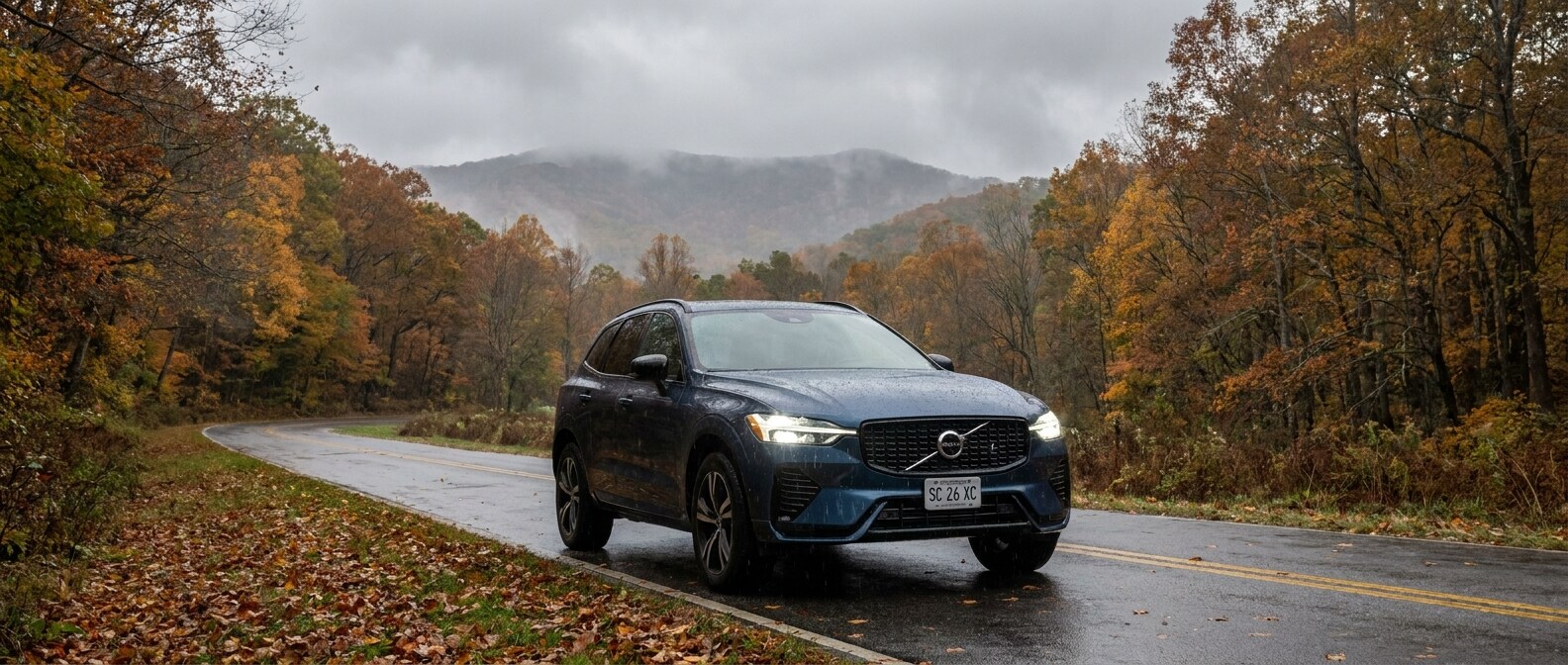
November in Greenville isn't a snow problem. It's a transition problem, and knowing the difference changes how you drive.
The bottom line is that SC-11, the Cherokee Foothills Scenic Highway, turns rewarding and demanding in the same week. Afternoon highs still touch the mid-60s downtown. Climb toward Caesars Head, though, and the temperature drops several degrees per thousand feet of elevation, so the pavement that felt fine at the trailhead becomes a different surface on the descent. The drivers who handle it well often skip the four-wheel-drive truck entirely. What they bring instead is a vehicle with the right systems active and set up for the season. The 2026 Volvo XC60 is a quietly sensible choice for exactly this drive, and the reasons come clear once you've mapped the specific conditions against the specific tools Volvo builds in as standard.
What's the Plan at a Glance?
The drive from Downtown Greenville to Caesars Head via SC-11 runs about 50 miles each way, and the table below lays out the key segments, what changes at each one, and what you'll actually want to watch along the route, from the ramps downtown to the shaded switchbacks up top.
| Segment | November Condition | What to Watch | Best Window |
|---|---|---|---|
| Downtown Greenville to I-85 | Wet leaves on ramps, low-angle morning sun | Visibility, stop distances on damp pavement | 9 a.m. onward |
| I-85 to SC-11 junction (Lake Hartwell) | Open roads, mild temperature | Tire pressure (check cold before departure) | Morning |
| SC-11 through Pickens County | Winding two-lane, forest canopy, wet pavement | Adhesion mid-curve, reduced sight lines | Midday |
| Table Rock area and above | Elevation gain, fog patches, possible ice at shaded pull-offs | Footing on gravel, descent braking | Midday strictly |
| Caesars Head approach | Upper 30s to low 40s even when Greenville reads 60 | Road surface at shaded switchbacks | Before 3 p.m. |
The Upstate's Real Winter Hazard Is Invisible
Greenville's average first freeze falls around November 12, per the National Weather Service record for Greenville-Spartanburg, and that date feels impossibly distant when the thermometer reads 65 at lunch, yet the cold is already doing quiet work on the pavement by the time you drive home. That date feels distant. It isn't.
The sequence goes like this. Afternoon temperatures run warm, so the pavement absorbs moisture. Overnight lows then slide into the mid-30s, and the surface that looked dry at checkout time refreezes in shaded corners. SC-11 through Pickens County runs under a hardwood canopy that holds shade long after sunrise. The 2026 Volvo XC90 comes with standard all-wheel drive across every trim and runs Pilot Assist, which provides lane-centering support and adaptive following distance on longer sections. The XC90's AWD continuously reallocates torque between axles as sensors detect slip, so the correction happens before you feel the problem. In a temperate climate the meaningful distinction has nothing to do with deep snow. The win is a system that catches a subtle surface change before you've had to make a decision.
A tire pressure piece here surprises Upstate drivers every November. Per NHTSA, ambient temperature drops of approximately 10 degrees Fahrenheit cost a tire roughly 1 PSI of pressure. Greenville's diurnal swing in November can span 25 to 30 degrees between an afternoon high and an overnight low. A tire holding 35 PSI after a warm afternoon can be sitting at 32 or 33 PSI when you back out at 7 a.m. The Tire Pressure Monitoring System won't trigger a warning until about 25 percent below the placard spec (that's the federal TPMS threshold). You're losing grip and accelerating wear before the light ever comes on. So check cold, first thing in the morning, against your door-placard number. For a November drive in the Upstate, that one step matters more than any gadget.
Our service team sees the same thing after a Greenville cold snap. Tires that were correctly set in September come in low by mid-November. The physics is real, per NHTSA. About 1 PSI per 10 degrees of ambient drop. A slow leak doesn't explain it. November does.
The SC-11 Drive Itself: What Changes at Elevation
SC-11, the Cherokee Foothills Scenic Highway, runs 119 miles along the southern edge of the Blue Ridge, from the Lake Hartwell area northeast toward Gaffney, and the Greenville-to-Caesars Head segment is the most dramatic stretch of the route by a comfortable margin. Our current Volvo lineup includes a range of AWD models suited to it, but here's what the drive itself actually demands.
Is early November still worth the trip? Yes, and the fall color is the reason. Sources covering the route note that fall color on SC-11 continues through early November. Fall color at elevation and stable driving conditions at elevation aren't the same thing, though. The section through Pickens County winds considerably, with limited sight lines and surfaces that stay wet in shade long after a rain has passed. Near Caesars Head, the route sits at higher elevation where ice can form after freezing rain even when the lower foothills are clear. You can still make this drive. Arrive in the right window (midday, not early morning) and descend before the light goes.
Deer are active through November in the Upstate foothills, moving at dawn and dusk, which is exactly when shaded mountain roads are coldest. The timing is where City Safety earns its keep.
City Safety, Volvo's standard collision avoidance system, uses a network of cameras, radar, and laser sensors to detect vehicles, pedestrians, cyclists, and large animals, applying automatic emergency braking when a collision is imminent. The large-animal detection isn't academic on SC-11. The 2026 XC60 carries it on every trim, standard.
Every 2026 Volvo XC60 and XC90 comes with standard all-wheel drive and standard City Safety automatic emergency braking, including pedestrian, cyclist, and large-animal detection, across every trim level.
Matching the Vehicle to the Drive
Matching a Volvo to this drive starts with one plain concession, that the brand's safety architecture builds confidence, and on a long mountain descent that same confidence can quietly slide into complacency if you forget the machine is assisting you rather than driving for you. Know what the system does. Know what it doesn't do.
The XC60 plug-in hybrid carries an additional consideration for cold mornings. Below about 40 degrees Fahrenheit, lithium-ion battery chemistry delivers reduced output. Plan for approximately 20 percent less electric range than the summer figure on cold morning departures. The right move is to precondition the cabin on grid power using the Volvo Cars app before you leave, warming the cabin and the battery pack without drawing from stored charge. Do that and the drive performs exactly as expected. Skip it and you're leaning on the engine more than you planned.
One thing City Safety does not do, and it matters a great deal. It does not shorten stopping distance on ice. No electronic system does. Stopping distance on wet or icy pavement is primarily a function of tires, their tread depth, and their temperature (cold rubber is less pliable and grips less). The 2026 XC60's standard adaptive cruise control adjusts following distance automatically on highway sections, building in physical separation. That separation creates time, and time is what City Safety converts into a corrective action. The chain only works if you don't eliminate the first link by following too closely.
We'll say this part plainly. SC-11 in early November is a beautiful drive, and we recommend it. The trailhead parking areas at Caesars Head and Raven Cliff Falls are gravel and hold moisture after rain. Dress for temperatures 10 to 15 degrees colder than Greenville. Descend before dusk. The Swedish engineering in your XC60 or XC90 was developed in climates that run this route in January, in the dark, on actual ice. Early November in Upstate SC sits well within its comfort zone. Go take the drive.
By the Volvo Cars Greenville Team | November 2026
Categories:
Social