
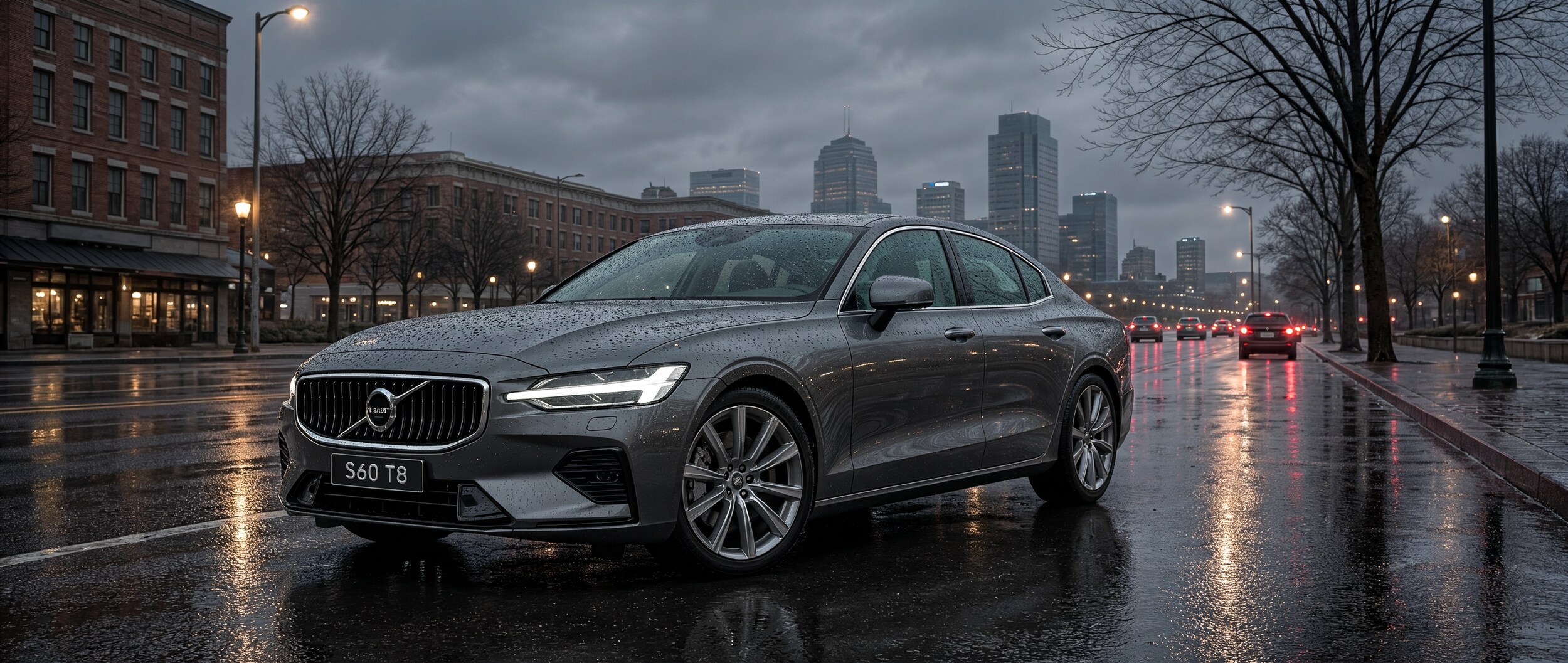
Greenville doesn't get many winter storms. We get the nastier kind instead: freezing rain on roads that haven't seen a treatment truck yet, with temperatures dropping just far enough to turn a wet overpass into glass. The Volvo S60 T8's eAWD system and 40-mile electric range are genuinely well-suited to that reality. Getting the most out of them, though, comes down to a few specific decisions you make before the cold arrives.
Here's what actually matters.
The short version
- All-season vs winter tires: The T8's eAWD is not a substitute for tire compound. On Greenville's freezing rain events, a winter-compound tire outperforms an all-season at temperatures below roughly 45 degrees (the rubber stays pliable when all-seasons start to firm up).
- Charging before cold mornings: A full charge lets the cabin pre-condition on grid power, not battery power, so you arrive at the interstate with the full 40 miles of electric range intact.
- Mode selection matters: Pure mode runs the rear electric motor alone. Hybrid mode blends the gas engine in earlier. For icy Upstate conditions, Hybrid or Power mode gives you both motors working together at launch.
- For the daily Greenville commute: Most Upstate commutes run well inside the 40-mile electric range, meaning the gas engine stays dormant on a typical day.
- Used-market reality: The 2025 model year is the last S60 T8 sold new in the U.S. This is now a used and CPO-market car, and that shapes how to think about setup and service.
Browse pre-owned Volvo inventory at Volvo Cars Greenville
What Actually Matters When Setting Up the S60 T8 for Winter?
Two decisions shape cold-weather performance more than anything else, and they're tire compound and charging discipline. The T8's powertrain architecture (a turbocharged 2.0-liter four-cylinder up front paired with a 143-horsepower rear electric motor) delivers 455 combined horsepower and 523 lb-ft of torque. That rear motor drives the rear axle on its own through a reduction gear, with no mechanical driveshaft tying it to the front engine. What that layout means for Upstate SC driving is worth understanding before the first ice event of the season.
| Variable | Why It Matters for Upstate SC | Best-Fit Choice | Tradeoff |
|---|---|---|---|
| Tire compound | Greenville's winter hazard is freezing rain and black ice, not deep snow | Dedicated winter tire (compound stays pliable below 45 degrees) | Twice-yearly swaps; storage without a second wheel set |
| All-season tires | Adequate for the mild majority of Upstate winters | Quality all-season with an M+S or Three-Peak Mountain Snowflake rating | Loses meaningful grip below 45 degrees vs a winter compound |
| Drive mode | Determines how the front engine and rear motor divide workload at launch | Hybrid or Power for ice launches; Pure for dry urban miles | Pure mode on glare ice sends the full launch load to the rear motor alone |
| Charging timing | A full overnight charge means pre-conditioning runs on grid power | Charge to full before cold mornings | Partial charges reduce pre-conditioning efficiency |
| Battery in cold | Lithium-ion capacity is lower at freezing temperatures | Pre-condition while still plugged in | Expect a modest range reduction on the coldest Upstate mornings |
Read the table above as your decision map. Everything below expands on the rows that carry the most weight for Greenville drivers.
Tire Compound Is the Variable the Powertrain Can't Override
The XC60 plug-in hybrid faces the same question, and the answer holds across Volvo's T8 lineup. With the wrong tire compound, 455 horsepower is slower on ice than 247 horsepower with the right one.
The S60 T8 weighs just over 4,400 pounds, heavier than its naturally aspirated sibling because of the 18.8 kWh battery pack sitting low in the floor. That low center of gravity genuinely helps cornering stability. It does nothing for stopping distance. Stopping distance comes down almost entirely to tire-surface grip.
Upstate SC's signature winter event is freezing rain. When the temperature sits between 28 and 36 degrees and rain falls on a bridge deck, it freezes on contact. I-85 and I-385 see this pattern several times a season, and the January 2026 ice storm left bridges impassable across the Greenville corridor. A winter-compound tire uses a silica-rich rubber that stays pliable at those temperatures. It deforms slightly against the road surface instead of skating across it. An all-season compound starts to firm up below 45 degrees and behaves more like a summer tire than the label suggests.
A note from our team: The S60 T8 came standard on 18- or 19-inch summer-biased performance tires on the sportier trims. Owners planning to keep the car through Upstate winters should check which compound is on their specific car before the season starts. Not all T8 trims shipped with all-season rubber.
Our service team can verify your tire compound and advise on a winter set
A second set of wheels with winter tires mounted drops the annual balancing and mounting cost per swap and turns the whole process into a 20-minute visit. You pay more upfront. You pay less over three or four seasons.
Understanding the eAWD Architecture in Cold Conditions
Most content about the S60 T8 misses this entirely, so start here. The car doesn't use a traditional mechanical AWD system. The rear electric motor drives the rear wheels through its own reduction gear with no driveshaft running from the front, while the front 2.0-liter handles the front axle. Software coordinates the two power sources electronically, which makes torque distribution between the axles a matter of code rather than a mechanical fix.
The XC90 plug-in hybrid uses the same architecture across its T8 variants. At cold-start, what we see is Pure mode handing the full initial workload to the rear electric motor, because the front engine is cold and the system prioritizes electric-first operation. On a dry morning, that's elegant for efficiency. On glare ice, it means the car launches from one axle. Switch to Hybrid mode on a frozen morning and the front engine joins in from the first inch of movement. You'll feel the difference right away.
- Hybrid mode: front engine active from startup, both axles contributing at launch
- Power mode: maximum combined output, both axles, most aggressive torque delivery at any speed
- Pure mode: rear electric motor only, front engine off, most efficient on dry or wet pavement
- AWD mode: specifically holds the front engine active and balances torque for slippery surfaces
Reach for the AWD drive mode on the center console and you've got the most useful tool on a Greenville ice morning. It isn't the same as simply having AWD engaged.
Match the Charging Habit to How You Actually Drive
Our financing team can walk you through used and CPO options on the S60 T8
The 18.8 kWh battery takes roughly five hours to charge on a standard Level 2 home charger (a 240-volt outlet). Overnight charging keeps it simple for anyone with a garage or driveway. For Greenville, the practical result is this. A driver commuting downtown, out toward the Greenville-Spartanburg International Airport corridor, or on the typical 15-to-20-mile Upstate round trip runs the whole day on electric power and gets home with range to spare.
Two specific reasons make that matter in winter. First, the cabin pre-conditioning feature draws from grid power while the car's still plugged in. The interior, seats, and steering wheel warm before you leave the driveway, so the battery reaches the highway fully charged rather than partially depleted by heating a cold cabin. Second, on short electric-range days the gas engine stays dormant, so it never cold-cycles on a morning when the weather keeps you close to home.
One limitation is worth stating plainly. In genuinely frigid temperatures (Greenville occasionally sees overnight lows in the teens), the available electric range runs a few miles short of the rated 40 miles, because the lithium-ion cells produce less usable energy when cold. On a typical Upstate winter morning, it's not dramatic. Plan a 10% buffer and the round trip still fits.
Frequently Asked Questions About the S60 T8 Winter Setup in Greenville
Does the S60 T8 need winter tires in Greenville, or will all-seasons do?
It depends on your tolerance for compromise and how often you drive during the Upstate's ice events. Through the majority of Greenville winters, a quality all-season tire handles typical conditions well enough. Where all-seasons fall short is the Upstate's specific hazard, freezing rain on bridge decks and overpasses when temperatures sit near 30 degrees. At those temperatures, an all-season compound has firmed up considerably, and the grip difference versus a winter compound is real on those surfaces. If you drive during ice events often (a commute on I-85 or I-385, for example), a dedicated winter tire set earns its cost.
What is the realistic electric range on a cold Greenville morning?
The S60 T8 is rated at 40 miles of electric range in standard conditions. On a genuinely cold Upstate morning (say, 25 to 30 degrees), expect somewhere between 34 and 38 miles of usable electric range, a modest reduction driven by the battery chemistry's lower output in cold temperatures. Pre-conditioning the cabin while the car's still plugged in recovers most of that gap, because the battery reaches a warmer operating temperature and the cabin's already comfortable. For most Greenville commutes, the round trip still fits comfortably inside the electric range even on the coldest days.
Schedule a Pre-Winter Service Appointment
The used-market angle deserves a direct word. After the 2025 model year, the S60 T8 is no longer sold new in the United States. Finding a well-specified example now means shopping pre-owned or certified. What doesn't change is the service need. An Upstate winter is the right time to have a Volvo-trained technician verify battery health, brake condition, and tire compound on a used T8 before the ice season. The car's architecture is sound. The setup is what you can control.
By the Volvo Cars Greenville Team | November 2026
Categories:
Social