
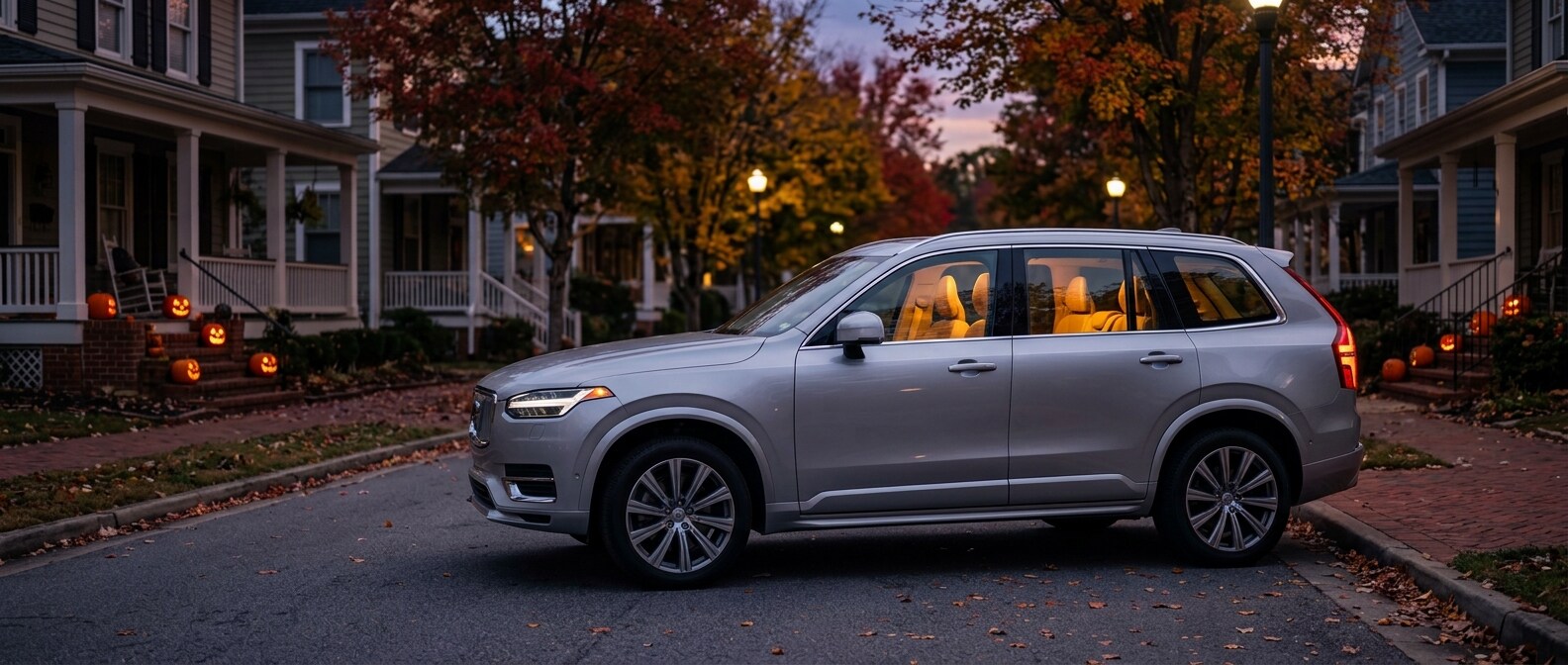
Halloween in Greenville is not a quiet night. The Trick or Treat on Main Street event runs through downtown on October 31, Earle Street off North Main draws crowds deep into the evening, and the Greenville Zoo's Boo in the Zoo fills the weeks leading up to it. All that foot traffic spills onto streets still shared with drivers running errands, heading home from work, and feeling their way through dark residential neighborhoods. The crowds and the cars share the same pavement.
The one-line answer is simple. Your Volvo already has the technology for this, and you just need to activate and configure it correctly before you pull out of the driveway.
According to a peer-reviewed study of 42 years of NHTSA data published in the Journal of the American Medical Association, pedestrian fatalities are 43% higher on Halloween than on any other night, with the sharpest risk window between 5 p.m. and 9 p.m.
The point of that number isn't alarm. It's a concrete reason to take three minutes before you drive on October 31 and make sure every system in your Volvo is actually on. Our team works through this checklist with every XC90 owner who asks, and it's the same for every model in the lineup.
What Your Volvo Needs Before You Leave the Driveway
Before you leave the driveway, the systems worth checking are the ones that only help when they're configured correctly, because a Volvo with City Safety switched off in the menus, or with automatic high beams left in manual mode, is a Volvo driving without its best tools. Halloween is not the night to discover that.
Run through this list before October 31 dusk.
| System | Where to Check | What to Confirm |
|---|---|---|
| City Safety (auto-brake) | Drive menu > City Safety | Enabled, not paused |
| Automatic high-beam LED headlights | Instrument cluster > Lighting | Set to Auto, not manual |
| Blind Spot Information System (BLIS) | Settings > Driver Support > BLIS | Active |
| Pilot Assist | Steering wheel controls | Off (not for neighborhood speeds) |
| Cross Traffic Alert | Settings > Driver Support | Enabled |
| 360-degree camera (if equipped) | Center display shortcut | Available at low speed |
One note on Pilot Assist. It shines on I-85 and I-385 at highway speeds. In a residential neighborhood at 15 mph, it's not the right tool, so turn it off. The other five systems listed above are exactly what the situation calls for.
One thing our Greenville team notices this time of year. The forward sensors sit behind the windshield and lower grille, and by late October a film of leaf grime and road dust can build up right where City Safety is looking, so a quick wipe of the camera area and lower fascia before dusk keeps it reading cleanly.
Six Steps to Configure Your Volvo for Halloween Night Driving
These six steps are the heart of the setup, and while none takes more than a minute on its own, the order matters, so work through them in your own driveway before dusk rather than improvising at the first crosswalk. None of it takes long.
Step 1: Enable City Safety and confirm pedestrian detection is active.
City Safety is Volvo's collision avoidance system. It uses radar and forward cameras to monitor for vehicles, cyclists, pedestrians, and large animals. One detail matters most on Halloween. on the XC60 and across the lineup, the pedestrian detection operates in the dark just as it does in daylight. Go to your Drive menu, select City Safety, and confirm it shows as active. If it was manually paused during a car wash or in a crowded parking structure and never re-enabled, you'll want to catch that now.
Step 2: Set your headlights to automatic high-beam mode.
Setting your headlights to automatic high-beam mode is the single most impactful change you can make for Halloween night visibility. Per the IIHS, vehicles with Good-rated headlights have 19% fewer nighttime single-vehicle crashes and 23% fewer nighttime pedestrian crashes compared to vehicles with Poor-rated headlights. The 2026 XC90's headlights earn a Good rating from the IIHS. On the 2026 XC60, the headlights earn an Acceptable rating (one tier lower). The gap between those ratings is real, and it's worth knowing. In both cases, setting the system to automatic high-beam mode lets the vehicle manage beam switching based on oncoming traffic, which means you're getting maximum illumination whenever the road ahead is clear.
Tip: This is the step easiest to skip. Many Volvo owners set their headlights to "On" rather than "Auto" and leave them there. In "On" mode, the automatic high-beam function doesn't engage. The light is on. The intelligence is not. Find the lighting stalk or the instrument cluster lighting menu and make sure it reads "Auto." It takes ten seconds.
Step 3: Activate BLIS and verify Cross Traffic Alert.
Volvo's radar-based Blind Spot Information System monitors up to 70 meters behind your vehicle, warning you via an indicator light in the door mirror when another vehicle is in your blind spot or approaching rapidly from behind. On Halloween, you're making more low-speed turns than usual, pulling over to let groups cross, and sometimes backing out of tight spots. Cross Traffic Alert handles that last scenario. It warns you of approaching traffic when reversing in situations where your sightlines are limited. Confirm both are active in Settings > Driver Support.
Step 4: Use Oncoming Lane Mitigation on any stretch of road with oncoming traffic.
If you're driving to an event and taking a two-lane road, Oncoming Lane Mitigation uses the forward camera to detect head-on collision risk from vehicles in the opposing lane and can actively apply a steering correction if you don't respond. Oncoming Lane Mitigation is on by default and works quietly. Worth knowing it's there.
Step 5: Lower your speed meaningfully, not nominally.
The posted limit in most Greenville residential neighborhoods is 25 mph. On Halloween between 5 p.m. and 9 p.m., 15 mph is closer to the right number. No technology substitutes for reaction time, and reaction time is a function of speed. City Safety auto-braking reduces the severity of a collision or prevents it when it detects an unexpected pedestrian, but its effectiveness increases the more time the system, and you, have to respond. Slower is safer, and it's also how the technology is designed to work best.
Step 6: Eliminate every in-cabin distraction before you enter a neighborhood.
Sync your playlist before you leave. Set your destination in Google built-in before you move. Every glance away from the road is several feet of travel at Halloween speeds. Think of this as the step that makes every other system more effective, no technology required.
Schedule a Pre-Halloween Vehicle Check
The one honest tradeoff to acknowledge: City Safety and BLIS are driver aids, not autonomous systems. They require the driver to be engaged and responsive. If you're watching your phone, the system's warnings are less useful because the reaction time advantage they create is gone. The technology is genuinely excellent. It still works with you, not instead of you.
The IIHS finds that Good-rated headlights correlate with 23% fewer nighttime pedestrian crashes compared to Poor-rated headlights. The 2026 Volvo XC90 earns a Good headlight rating; the 2026 Volvo XC60 earns Acceptable. Both are in the upper tier of the segment, but the gap matters when you're choosing between them for night-driving duty.
Your Quick-Reference Recap for October 31
Keep this recap somewhere you can glance at it, whether that's a printout or a screenshot on your phone, and run through it in the driveway before you pull out on October 31, so the whole setup is finished before the first group of kids rounds the corner. It takes about a minute.
| Step | Action | Status |
|---|---|---|
| 1 | City Safety: enabled and active | Check in Drive menu |
| 2 | Headlights: set to Auto (not just On) | Check lighting stalk or cluster |
| 3 | BLIS and Cross Traffic Alert: active | Settings > Driver Support |
| 4 | Oncoming Lane Mitigation: on by default | No action needed; good to know |
| 5 | Speed: 15 mph or lower in residential areas | Your judgment |
| 6 | Distractions: handled before you move | Phone away, nav set |
If your Volvo has the optional 360-degree surround camera, add one more step. Use the bird's-eye view at any low-speed parking or backing maneuver. Our service team can verify that all your safety systems are calibrated and functioning before Halloween night if you have any uncertainty about a feature's behavior or if a warning light has appeared recently.
Halloween falls on Saturday, October 31, 2026 this year, which means evening foot traffic will be heavier than a weeknight. Plan your driving window accordingly. Earlier in the evening, when it's still partly light, is meaningfully safer than after full dark.
By the Volvo Cars Greenville Team | October 2026
Frequently Asked Questions
Does City Safety work at night on a Volvo XC60 or XC90?
Yes. The City Safety system on both the 2026 XC60 and the 2026 XC90 includes pedestrian detection that operates in nighttime conditions as well as in daylight. The system uses radar and forward cameras to process the road ahead. Nighttime detection comes standard on every trim rather than as an add-on. The 2026 XC60 earned an advanced rating for nighttime pedestrian crash prevention from the IIHS.
Is Pilot Assist useful in residential neighborhoods during Halloween?
Not for this specific purpose. Pilot Assist combines adaptive cruise control with lane-centering steering input and is designed for marked highway driving, where it works well on routes like I-85 or I-385. In a residential neighborhood at 15 mph, with frequent stops, pedestrian crossings, and the need for manual steering judgment, Pilot Assist should be off. City Safety, BLIS, Cross Traffic Alert, and the automatic high-beam headlights are the relevant active systems for neighborhood Halloween driving.
Categories:
Social