
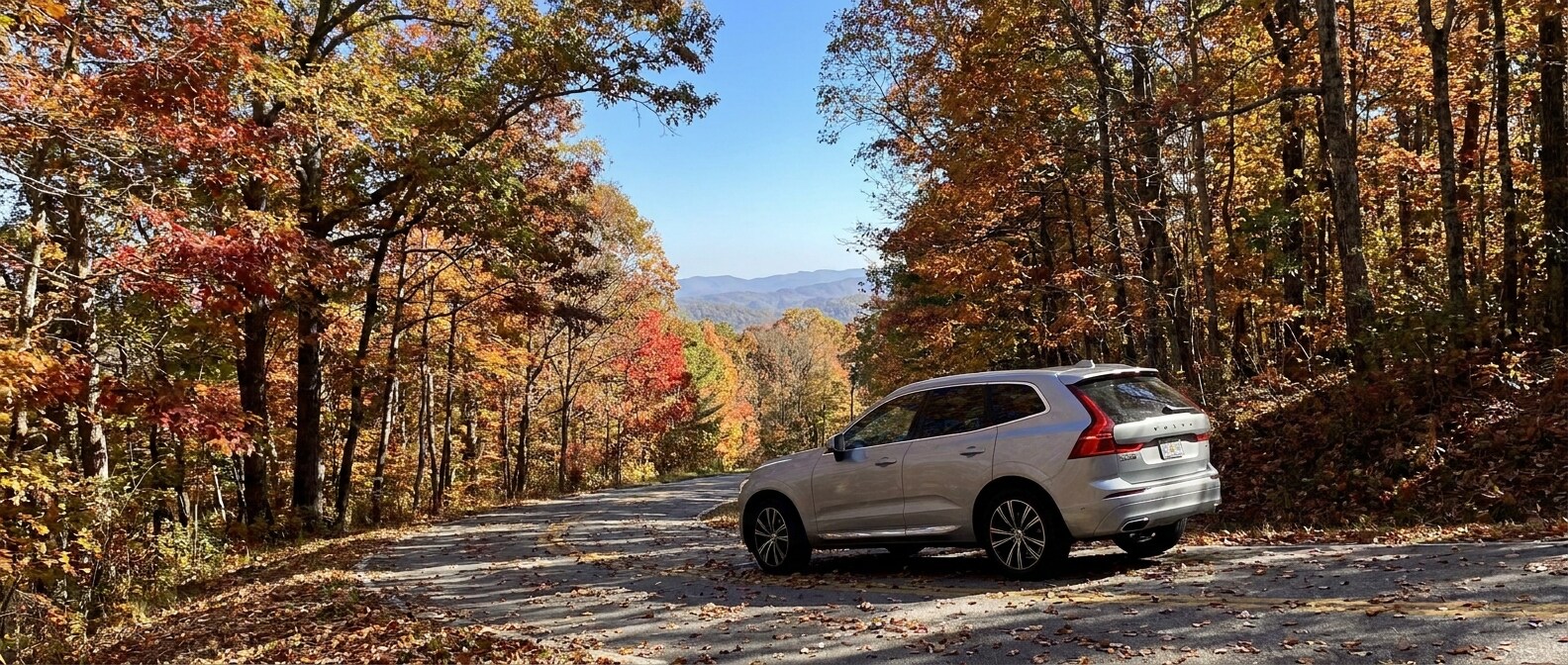
Volvo's Hill Descent Control (HDC) is a low-speed braking assist that holds your SUV to a controlled crawl on steep downhill grades, so you can steer instead of ride the brake pedal. It works through the Off Road drive mode, operates at speeds up to approximately 25 mph, and sets a default crawl of around 6 mph forward, which means the vehicle keeps that pace on its own no matter how the gradient shifts under you.
The Volvo XC60 carries this feature as part of its Off Road drive mode on AWD trims, which makes it genuinely relevant for Upstate SC owners who venture beyond I-85.
What Does Hill Descent Control Actually Do on a Steep Grade?
Hill Descent Control turns the brake system into an automatic pace-keeper, so your foot can stay on the accelerator (or off both pedals) while your hands stay on the wheel. On a steep descent, ordinary engine braking gets outpaced by gravity. Gravity wins. The gap only widens with passengers and cargo aboard.
Volvo's system, as the brand's own support documentation describes it, engages enhanced engine braking and, when that isn't enough, applies the brakes automatically to hold a steady, very low speed. You set the pace with the accelerator pedal. Release it, and the car eases back to crawling speed regardless of how steep the hill gets, no foot brake required.
| Scenario | Without HDC | With HDC Engaged |
|---|---|---|
| Steep unpaved descent | Driver brakes manually, potential for brake fade on sustained grades | System holds approx. 6 mph forward automatically; driver focuses on steering |
| Boat ramp reversal | Driver feathers brake in reverse on wet concrete | System holds approx. 4 mph rearward; consistent pace on slippery surface |
| Gravel forest road descent with passengers | Load increases brake demand; risk of overcorrection | System compensates automatically for load and gradient |
| Wet pavement on a public highway | HDC is not designed for this scenario | HDC is not designed for this scenario |
That bottom row is the tradeoff we're straight with every buyer about. Hill Descent Control is built for low-speed, off-road or rough-surface conditions, and it isn't a wet-road highway assist. On a rain-slicked I-385 ramp, your Volvo's standard stability control and all-wheel drive are the systems doing the work. HDC stays quiet there, by design.
Which Volvo Models in Our Lineup Include Hill Descent Control?
Hill Descent Control is tied to AWD and the Off Road drive mode, so it lives on specific configurations rather than across the whole lineup. On models without a physical drive mode controller on the center console, you'll find the function as a button in the center display's function view instead.
| Model | HDC Included | Activation Method |
|---|---|---|
| XC60 (AWD, B5 or B6 mild hybrid) | Yes | Off Road drive mode |
| XC60 Recharge plug-in hybrid | Yes | Off Road drive mode |
| XC90 (AWD) | Yes | Off Road drive mode |
| XC90 Recharge plug-in hybrid | Yes | Off Road drive mode |
| XC40 (with drive mode button, AWD) | Yes | Off Road drive mode |
| V60 Cross Country (AWD) | Yes | Center display or console button |
| EX30, EX90 (full electric) | Verify with our team at time of purchase | Varies by configuration |
The practical takeaway is simple. If your Volvo has AWD and a selectable Off Road mode, HDC is almost certainly part of the package. Front-wheel-drive configurations and pure city-spec trims typically leave it out.
On any AWD Volvo XC60 or XC90 with Off Road drive mode, Hill Descent Control is included standard and engages automatically as part of that mode at speeds below approximately 25 mph.
Our team's read on this feature: The owners who get the most out of HDC in Upstate SC tend to be the ones backing a boat trailer down a wet concrete ramp at Lake Keowee or Lake Hartwell. That slow, controlled reverse on a slippery gradient is exactly the use case Volvo's own support documentation singles out. SC-11 through the Cherokee Foothills has sections where a loaded XC90 earns the consistent crawl speed on gravel pull-offs near Caesars Head, too. If you never leave paved roads, the system stays dormant.
Is Hill Descent Control Worth Seeking Out When Choosing a Volvo?
For Upstate SC buyers, the honest answer is that HDC probably won't be a deciding factor on its own, and that's fine, because it comes bundled rather than priced out as a standalone. It matters when you need it, and it asks nothing of you when you don't.
Because HDC is included as part of Off Road mode on every AWD XC60 and XC90, you aren't paying a separate option for it. You're choosing an AWD Volvo for the traction in wet October weather or on mountain back roads, and HDC rides along with no added cost or complexity. The feature doesn't ask you to think about it on a normal drive. Pick Off Road mode when the grade calls for it, and the system handles the rest.
Where it does shape a purchase is for the driver who regularly hits gravel approach roads near Mountain Bridge Wilderness Area or pulls a trailer down a sloped launch ramp. In those cases, the XC90's higher seating position and added load capacity make the HDC function feel noticeably more confident than managing the same descent by foot. You can measure that difference in how the vehicle behaves; it isn't a brochure claim.
Keep the limits in mind. It won't stand in for winter tires on ice, provide meaningful assist at highway speeds, or engage on flat or mild slopes. Those are worth knowing before you lean on it.
Frequently Asked Questions
What speed does Volvo's Hill Descent Control maintain?
Volvo's Hill Descent Control holds the vehicle to approximately 6 mph (10 km/h) moving forward and approximately 4 mph (7 km/h) in reverse. The system operates at low speeds, up to approximately 25 mph (40 km/h), and deactivates automatically above that threshold. You can press the accelerator to move faster within the gear range, and the car returns to crawling speed when you release the pedal.
Does Volvo's Hill Descent Control work on wet pavement?
Hill Descent Control is designed specifically for low-speed off-road and rough-surface descents, not for wet pavement on public roads. On wet or slippery paved surfaces, your Volvo's standard electronic stability control and all-wheel drive are the active systems. HDC is dormant in those conditions by design. Volvo's own guidance notes the Off Road drive mode it activates with "is not designed to be used on public roads" at normal speeds.
How do I turn on Hill Descent Control in my Volvo XC60 or XC90?
On the current 2026 XC60 and XC90 with a drive mode controller, select Off Road mode before your descent. Hill Descent Control activates automatically as part of that mode once your speed is within range. On vehicles without a physical drive mode control in the center console, look for the HDC button in the center display's function view. An indicator light illuminates when the function is active. If you deactivate it while descending a steep grade, the braking effect decreases gradually rather than cutting off immediately.
Categories:
Social