
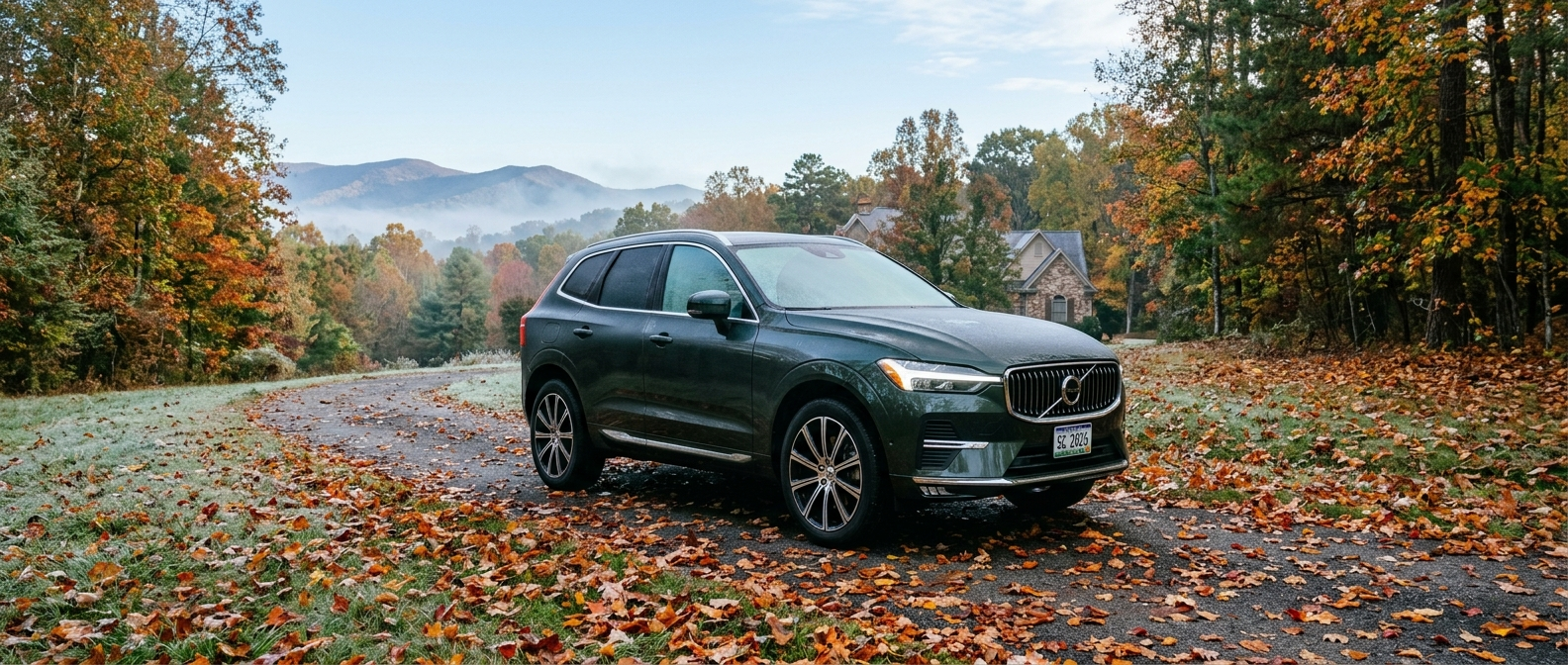
Greenville hit 88 degrees last week. This weekend, overnight lows are forecast to fall into the 40s, and the National Weather Service puts our Upstate median first frost at right around November 2. A 40-plus-degree swing like that comes on quietly. The whiplash is a warm-to-cold turn that feels too mild to matter right up until a TPMS light comes on at 7 a.m. or a Recharge battery shows a snowflake on the display.
October is the month to act, well before December and well before anything actually feels off. Our service team at Volvo Cars Greenville runs a specific sequence for Upstate fall prep, and the checklist below is the one we've built for it.
What Goes on the October Winter Prep Checklist?
The checklist below covers tires, battery, coolant, filters, wipers, brakes, and lights, plus a short Recharge section, and every line maps to a system the Upstate's particular weather pattern actually stresses rather than generic cold-climate boilerplate. We've ordered it so you can work through it top to bottom, print it, and bring it to your appointment as a starting point.
The Volvo Cars Greenville October Prep Checklist
- [ ] Tire pressure set to door-placard spec (cold reading, morning check)
- [ ] Tire tread depth measured at four points per tire
- [ ] Battery load test (especially any battery three or more years old)
- [ ] Battery terminals inspected for corrosion and snug connections
- [ ] Engine coolant concentration verified (50% glycol protects to approximately -35 degrees Fahrenheit, per Volvo specification)
- [ ] Coolant hoses and clamps inspected for soft spots or loosening
- [ ] Oil condition and level checked; oil change scheduled if due
- [ ] Windshield wiper blades inspected and replaced if streaking
- [ ] Washer fluid topped with a winter-blend fluid rated for freezing temperatures
- [ ] Cabin air filter replaced if not done in the last 12 months
- [ ] Brake pads and rotors inspected (wet leaves reduce stopping performance)
- [ ] All exterior lights confirmed working, lenses clear
- [ ] Climate control system and rear defroster tested
- [ ] Recharge and EV owners: battery preconditioning schedule confirmed active in Volvo app
- [ ] Recharge and EV owners: charging cable and charge-port cover inspected
Why Each Item Matters for Upstate SC Driving
A few items on this list feel obvious enough that you don't need the explanation, while a handful are specific to how the Upstate's climate behaves, and understanding the climate-driven ones is what keeps a mild winter from turning into an expensive repair. Those are the ones worth pausing on.
Tire Pressure: The Item That Surprises Greenville Drivers Every October
A TPMS light that flicks on out of nowhere on a cool morning is almost always simple physics at work, the air inside your tires contracting as the overnight temperature falls, so the car reads low even though it's perfectly fine. According to NHTSA, tire pressure drops by approximately 1 PSI for every 10 degrees Fahrenheit decrease in ambient temperature. Greenville's current swing (88 degrees Fahrenheit highs earlier this week, 40s overnight by the weekend) represents a potential 4 to 5 PSI loss in tires that were perfectly set last month. That alone can bring a tire from its recommended pressure into territory where traction is reduced and tire wear accelerates.
The XC60's door placard lists the specific cold-inflation spec for your trim. Trust the label over memory, and check the tires before the car's moved for the day. A warm tire reads high.
A note on tread: Volvo recommends tires have adequate tread depth before wet and cold conditions. Check four points per tire (inside, outside, and two center positions). Uneven wear across those four points is its own conversation about alignment. If you're close to the wear indicator, October is the time to handle it before Paris Mountain State Park trails get their first wet-leaf coating.
Battery: Where Greenville's "Mild" Winter Actually Bites
Battery trouble is where the Upstate's mild reputation quietly works against owners, since cold weather cuts into a battery's ability to deliver its full cranking power and that curve gets steep below 40 degrees Fahrenheit, so a battery that tested fine in August can struggle once the nights turn. A battery that tests fine at 80 degrees Fahrenheit may not have enough reserve to crank reliably on a 35-degree morning. Batteries aged three to five years deserve a load test, not just a voltage check. A voltage check tells you the resting state; a load test tells you what's actually happening under starting demand.
XC90 and XC60 plug-in hybrid owners carry both a conventional 12-volt battery (for the vehicle's electronics and starter systems) and the high-voltage drive battery. They've both earned a look. The 12-volt in particular gets overlooked by Recharge owners who assume the high-voltage system covers everything.
Coolant: The Spec That Actually Matters
Volvo specifies engine coolant at a 50% glycol concentration, which provides freeze protection to approximately -35 degrees Fahrenheit, a level of cold South Carolina winters almost never approach, so freezing itself isn't really why this check matters in the Upstate. But a coolant that has degraded or been diluted with water loses that protection and, more importantly, loses its corrosion-inhibiting properties, which means internal engine and hose damage that isn't visible from the outside. Our technicians test concentration with a refractometer, not a guess. That check takes two minutes.
Cabin Air Filter: The One Owners Consistently Skip
A clogged cabin air filter does a lot more than dull the air quality inside the car, because it restricts airflow through the entire HVAC system, so your defrost takes noticeably longer on a cold morning and your heater has to work harder to keep up. You'll feel it on the first cold start.
In our Greenville service lane, a filter that's gone a full pollen season without a change makes itself obvious, loaded with that yellow Upstate film long before anyone notices it at the vents.
On a 42-degree drive on I-85 heading toward GSP, a fogged windshield that takes three minutes to clear instead of forty-five seconds is a real problem. Volvo's general guidance is to replace the cabin filter every 12 months. If you can't remember the last time it was done, October is the right time to take care of it.
Schedule Your October Service Appointment
For Recharge and EV Owners: The Cold-Battery Conversation
Recharge and full-electric owners get a section of their own here because the standard winter-prep checklist written for a snow state never really addresses what a cold battery does in a mild Southern climate like the Upstate, where a hard freeze is rare but a 40-degree morning isn't.
Volvo's own documentation for the EX90 and EX30 states clearly that when the battery is cold, the vehicle temporarily reduces performance until the pack warms up. Studies across EV models consistently show roughly a 20% reduction in range in freezing weather, with that figure climbing in deeper cold. Greenville doesn't see extended deep freezes, but a 40-degree morning is enough to trigger reduced performance on a cold-soaked battery. A cold pack gives up range. No setting fully erases that.
The fix Volvo specifies is straightforward. Connect the vehicle for charging while parked, and activate preconditioning through the Volvo app before your trip. The car heats the battery using grid power, not range, so you leave home with a warm pack and your full available range intact. If you haven't set up a preconditioning schedule in the app yet, October is exactly the right time.
For Recharge and EV owners: preconditioning before departure is the single highest-impact cold-weather habit, and it costs nothing if you're plugged in at home.
| Service Item | Why It Matters in the Upstate |
|---|---|
| Tire pressure check | 1 PSI drops per 10 degrees Fahrenheit swing; Greenville's October range hits 40-plus degrees in a week |
| Battery load test | Cold cranking performance drops below 40 degrees Fahrenheit; voltage alone doesn't reveal the gap |
| Coolant concentration test | 50% glycol spec prevents corrosion and freeze damage; degraded fluid is invisible |
| Cabin air filter | Restricted airflow slows defrost and heat on cold I-85 and I-385 commutes |
| Wiper blades and winter fluid | Streaking and frozen fluid compromise visibility on wet leaf-covered roads |
| Recharge preconditioning check | Cold packs reduce range roughly 20%; preconditioning on grid power preserves full range |
| Brake inspection | Wet leaves and cool temps reduce friction pad effectiveness; early inspection avoids surprises |
Your Print-and-Go Recap
Print this recap and bring it to your service appointment, or keep it by the door as a driveway checklist to run before you call us, so nothing on the list has to wait for the cold morning that'll force the issue.
Before the cold arrives:
- Tire pressure (cold, morning, door-placard spec)
- Tire tread depth at four points per tire
- Battery load test, not just a voltage check
- Coolant concentration confirmed at 50% glycol
- Cabin air filter replaced if due
- Wiper blades inspected; winter washer fluid in the reservoir
On your first cold morning:
- Note whether the TPMS light appears (normal physics; add air and recheck)
- Recharge/EV owners: confirm preconditioning ran before you unplugged
What our team handles at the appointment: coolant refractometer test, battery load test, brake pad depth measurement, full light inspection, and a visual on hoses, clamps, and belts. If you're overdue on oil, we'll flag it. If your cabin filter is restricted, we'll show you what we found.
Frequently Asked Questions
Does a Volvo really need winter prep in Greenville if it almost never snows?
Yes, and the Upstate's mild winters are actually part of why it matters. The challenge here comes down to how fast the temperature swings, and deep sustained cold barely registers while a warm week flipping to a frosty one hits every system at once. When temperatures drop from the 80s to the 40s in a matter of days, tire pressure falls by roughly 4 to 5 PSI, batteries face their first cold-cranking demands of the season, and coolant that has never been tested is suddenly doing its job. None of those are snow events. All of them are October events in Greenville, and they're here before the first frost arrives around early November.
What's different about winter prep for a Volvo Recharge plug-in hybrid or EV?
Recharge and full-electric models give you two batteries to think about, the high-voltage drive battery and the conventional 12-volt system. Both get inspected during service. The habit that matters most for Recharge drivers is activating battery preconditioning through the Volvo app before heading out on cold mornings. Per Volvo's guidance, preconditioning heats the battery while the car is still plugged in, so you leave home with a warm pack and full available range already in hand. It's a simple setting that makes a measurable difference once Greenville's overnight lows consistently stay below 50 degrees Fahrenheit.
Categories:
Social