
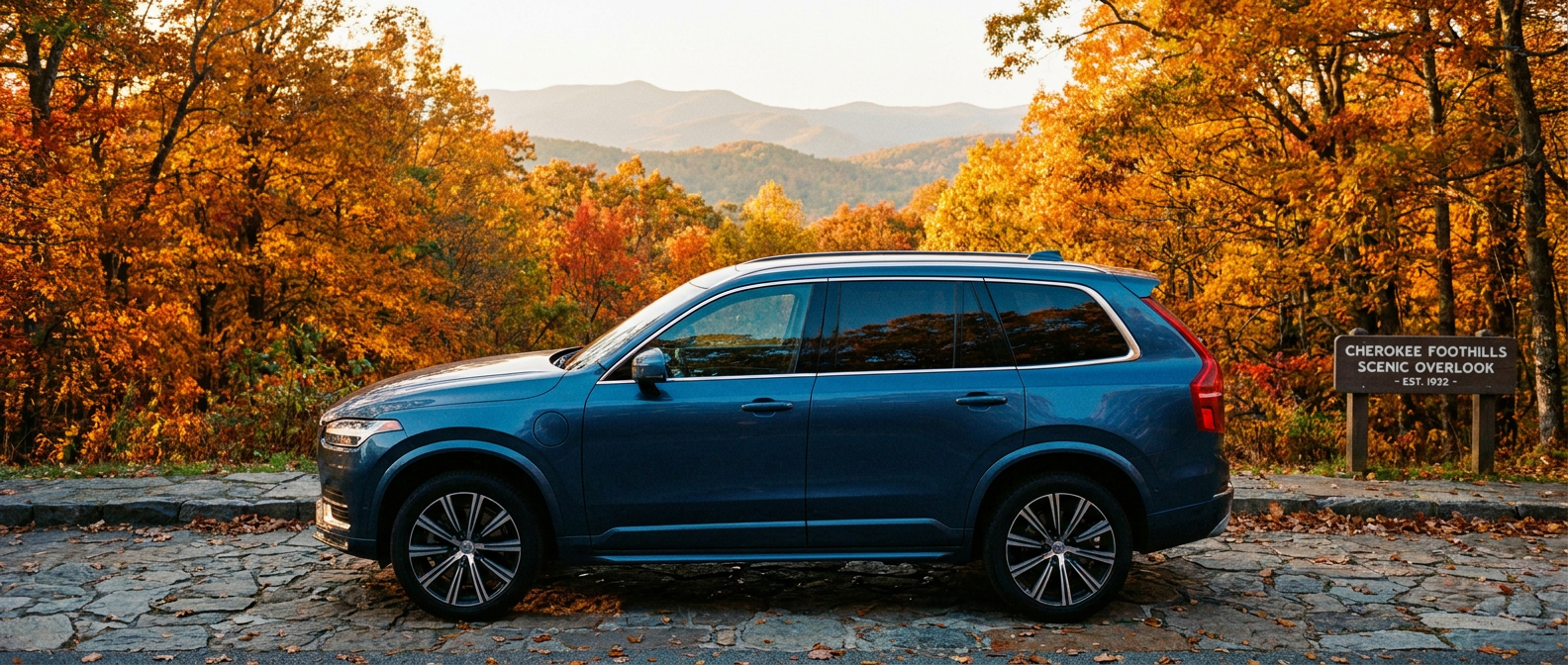
What do drivers actually want to know about the T8? Not horsepower, as it turns out. On the floor the questions run more like this, whether charging it every night really means using less gas, and what happens when the road tips uphill.
Both are fair questions. The 2027 Volvo XC90 T8 plug-in hybrid doesn't run on a single engine that moonlights as a motor. Its architecture works differently. Volvo routes a turbocharged 2.0-liter four-cylinder through an eight-speed gearbox to the front wheels, while a separate electric motor, mounted entirely at the rear axle, handles the back wheels independently. That separation is what makes eAWD possible, what gives Power mode its authority on a highway on-ramp, and what lets Pure mode feel genuinely silent on a downtown Greenville street. Before you decide whether the T8 is the right powertrain for you, it helps to know exactly what it's doing.
The XC90 T8 puts a separate electric motor on the rear axle. Independent of the gas engine up front, so each drive mode changes which source of power is active, not just how much fuel it uses.
How Does the T8 Powertrain Actually Work?
At its core the T8 is two separate drivetrains sharing one body, coordinated by software, and Volvo lists the 2027 system output at 401 horsepower and 494 pound-feet of torque from pairing the front gas engine with a 154-horsepower electric motor at the rear. Neither component alone produces those numbers. The gas engine drives forward traction while the electric motor handles rear traction. The split sidesteps the traditional transfer-case AWD entirely, and it's mechanically elegant.
The battery feeding that rear motor carries a 19-kWh gross capacity, approximately 18.8 kWh usable. Volvo rates it for up to 33 miles of EPA-estimated all-electric range. Charge it to full and the rear motor can sustain highway speeds in Pure mode without waking the gas engine. Let the battery drain below its threshold, and the system hands the load to the gas engine seamlessly. At normal throttle you won't feel the handoff.
One more piece of the architecture worth knowing. The XC90 T8 doesn't support DC fast charging, and replenishment runs through a 3.6-kilowatt onboard charger. A full charge on a Level 2 connection at 240V takes roughly five hours, so the right move is an overnight routine at home. Plan around the garage.
| Feature | Spec (2027 XC90 T8) |
|---|---|
| Gas engine | 2.0L turbocharged four-cylinder, front-wheel drive |
| Electric motor | 154 hp, rear axle only (independent of gas engine) |
| Combined system output | 401 hp / 494 lb-ft torque |
| Battery (gross / usable) | 19 kWh / ~18.8 kWh lithium-ion |
| EPA electric-only range | Up to 33 miles |
| EPA combined fuel economy | 58 MPGe (charge-depleting) / 27 MPG (gas-only) |
| Level 2 charge time (0-100%) | ~5 hours at 3.6 kW |
| DC fast charging | Not supported |
| Drive modes | Pure, Hybrid, Power, Constant AWD, Off-Road |
| Seating | 6 or 7 (configuration-dependent) |
Which Mode Do You Actually Need for Upstate SC?
Here the five drive modes turn from a spec-sheet footnote into a practical decision tool, and we'll be specific about each one, because vague mode descriptions don't help anyone choosing a vehicle for SC-11 on a Saturday or I-385 during a morning merge.
Hybrid mode is the default every time you start the car. The system balances electric and gas power on its own, leaning on the battery when demand is low and calling in the gas engine when you ask for more. It regenerates charge through gentle braking. For mixed daily driving between Greenville neighborhoods, the dealership on Duvall Drive, and a weekend run toward Lake Keowee, Hybrid mode handles it without any input from you. Call it the sensible baseline.
Pure mode commits to the rear electric motor for as long as the battery allows. No engine noise, no fuel burn, no tailpipe output while the charge lasts. On a 33-mile EPA-rated range, a typical Greenville in-town day (errands, school run, downtown Falls Park) fits comfortably within that window on a full charge. One note worth flagging. If you push the accelerator past a certain threshold in Pure, the gas engine starts. Pure rewards a measured right foot.
Power mode brings both drivetrains online simultaneously. Steering sharpens, suspension stiffens slightly, gear changes arrive more crisply. On the long uphill grades of SC-11 Cherokee Foothills National Scenic Highway, where a three-row seven-passenger SUV at 5,000 pounds can feel its own weight on switchback climbs, Power mode puts 401 combined horsepower and 494 pound-feet of torque to the road in a way that feels effortless. It uses fuel faster. The tradeoff is fair, and for that road it's the right one.
Constant AWD mode locks both the gas engine and electric motor on continuously, holding all four wheels in drive. Volvo recommends it for slippery conditions or towing. Upstate SC doesn't get sustained ice, but leaf-covered gravel pull-offs at Paris Mountain State Park in October are slick enough to notice. On a fall weekend it earns its place.
Off-Road mode raises ground clearance and activates hill descent control at speeds under 15 mph. It's available on unpaved access roads to trailheads and campsites. A note on its limits. The raised suspension deactivates automatically above 15 mph, at which point the system reverts to Constant AWD. Off-Road is built for slow-speed technical terrain, not gravel highways.
The XC60 T8 plug-in hybrid shares the same fundamental powertrain architecture if a smaller three-row isn't a hard requirement. The XC90 mild hybrid (B5 and B6) is available for drivers who prefer a plug-free ownership experience with a 247- or 295-horsepower gas powertrain. Neither matches the T8's combined output or its electric-only range, but they're relevant comparison points if the plug-in setup isn't the right fit for your routine.
| Drive Mode | How it Works | Best Upstate SC Use |
|---|---|---|
| Hybrid | Gas + electric coordinated automatically; regenerates under braking | Daily Greenville commuting, mixed suburban driving |
| Pure | Rear electric motor only; gas engine off while battery allows | In-town errands, Falls Park runs, short 33-mile local loops |
| Power | Both drivetrains simultaneously; sharpened steering and suspension | SC-11 mountain grades, I-385 highway merges, passing at speed |
| Constant AWD | Both drivetrains locked on; maximum traction | Wet leaf-covered roads, gravel overlooks, light towing |
| Off-Road | Raised suspension, hill descent control, locked AWD below 15 mph | Trailhead access roads, unpaved park approaches |
One tradeoff worth naming directly: The 2027 T8's combined output is 401 hp, compared to 455 hp in the 2026 model. Volvo updated the engine to a next-generation calibration. In our experience, the difference in everyday driving feel is minimal, the torque figure of 494 pound-feet is what you feel off a standstill, and that number is generous. But if you're comparing 2026 and 2027 T8 spec sheets, that's the change to note.
Quick Terms: T8 Vocabulary Plain
| Term | What It Means |
|---|---|
| T8 | Volvo's designation for the plug-in hybrid powertrain; turbocharged gas engine plus rear electric motor |
| eAWD | Electric all-wheel drive achieved without a mechanical connection between front and rear axles |
| MPGe | Miles-per-gallon equivalent: a standardized way to compare electric efficiency to gasoline (EPA rates the XC90 T8 at 58 MPGe in charge-depleting operation) |
| Charge-depleting vs. charge-sustaining | Charge-depleting: running on a full battery, using electric power first. Charge-sustaining: battery depleted, running as a conventional hybrid on 27 MPG |
What This Means for Your Next Vehicle
If your daily routine in Greenville stays mostly within a 30-mile radius, a full overnight charge sends you to work, back, and through afternoon pick-up on electricity alone in Pure mode, with the gas engine sitting in reserve as a long-range backup rather than the default. For the family that heads up SC-11 toward Caesars Head State Park on fall weekends, the full 401-horsepower Power mode and the complete gas range cover the round trip without anxiety about finding a charger in the mountains.
The honest version is simpler. If you won't plug it in consistently, the efficiency case weakens. The EPA's gas-only figure of 27 MPG, combined and charge-sustaining, is respectable for a three-row luxury SUV at this weight, even if it never becomes transformative. The T8 rewards the driver who charges nightly and uses Pure for short loops, then switches modes thoughtfully on longer drives. Really it's a behavioral fit question as much as a vehicle question.
On a cold Upstate morning the battery gives up a little range before it warms, something worth planning a Pure-mode loop around. Owners who match the T8's rhythm, a home garage and a predictable weekday routine, tend to be surprised by how rarely they stop for fuel. The architecture earns that outcome, and it rewards knowing how to use it.
Browse our full XC90 lineup in new inventory to see current trim availability, including both the Core and Ultra configurations of the 2027 T8.
Frequently Asked Questions
Does the XC90 T8 plug-in hybrid work without charging?
Yes. The T8 functions as a conventional hybrid if you never plug it in. The gas engine and electric motor still work together in Hybrid mode, and the battery captures energy through regenerative braking. You won't get the full EPA-estimated 33 miles of electric-only range that way, and the car's EPA gas-only combined rating of 27 MPG is its floor rather than its ceiling. The system doesn't require charging to operate. It simply rewards consistent charging with significantly better efficiency in everyday driving.
How long does it take to charge the XC90 T8 at home?
On a Level 2 (240-volt) connection, Volvo rates the full 0-to-100-percent charge at approximately five hours using the 3.6-kilowatt onboard charger. A standard 120-volt household outlet can charge the battery but takes considerably longer. Volvo's figures point to around eight hours. The vehicle doesn't support DC fast charging. Most owners we speak with install a dedicated Level 2 wall unit in their garage and let it run overnight, arriving each morning with a full battery ready for Pure mode.
Categories:
Social