
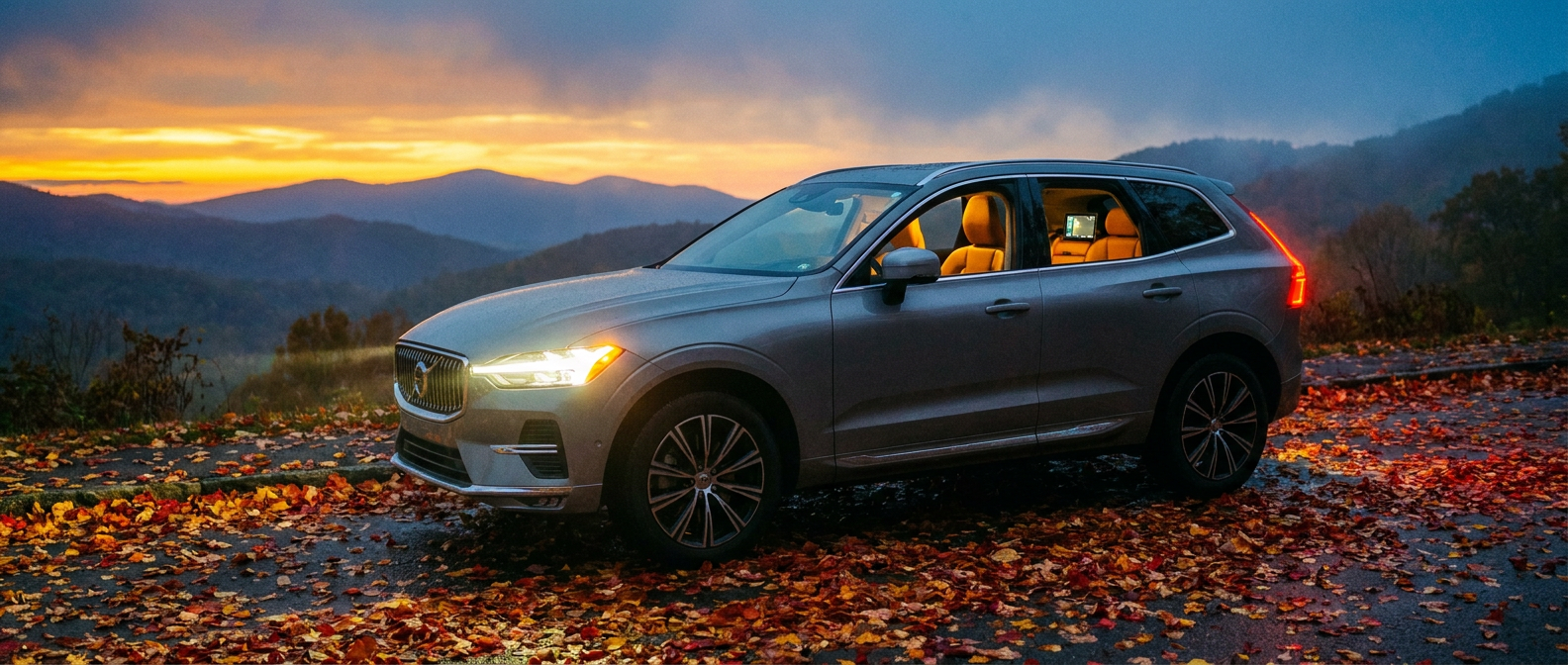
Sunset in Greenville slides from roughly 6:39 p.m. to 5:35 p.m. the moment clocks fall back on November 1. No gradual seasonal easing here. A full hour of darkness lands overnight, right in the middle of the evening commute on I-385 or I-85. Your Volvo is engineered for exactly this transition, though a handful of settings and maintenance items decide whether that engineering performs the way it should. Get them right and the car does what it was built to do. Get them wrong and you're running safety technology at a fraction of its capability.
We'll name the tradeoff up front. Greenville's November is mild by most standards, with average highs in the low-to-mid 60s and lows near 40 degrees Fahrenheit. None of this is winter prep. What the clock change does is compress your driving into darker hours faster than any other single calendar event. The items below make sure your Volvo's camera-dependent safety systems, your lighting, and your interior visibility are calibrated for that new reality.
See what our service team checks before November
The short version
- Headlights: Confirm your setting reads "Auto," not "On." The automatic high-beam function only activates in Auto mode, regardless of whether the lights themselves are on.
- Wiper blades: Pilot Assist and Lane Keeping Aid rely on a forward-facing camera. Worn blades that streak across the lens affect what those systems can see.
- Cabin air filter: Volvo's maintenance guidance calls for replacement at least once a year. A clogged filter reduces airflow to the defroster, which means slower window clearing in damp November mornings.
- Interior windshield: Clean the inside surface. Road grime accumulated over summer scatters oncoming headlights into glare that's far worse at night than in daylight.
- City Safety: Operates consistently across lighting conditions, but effectiveness can be reduced in heavy rain or fog. Conditions Greenville November delivers regularly.
What Actually Matters When You're Driving Into an Earlier Sunset?
Four variables decide how well your Volvo handles the post-DST commute, starting with whether your headlight mode lets the automatic high-beam system engage, whether the forward camera has clean glass to read lane markings through, whether the cabin air filter is fresh enough to feed the defroster, and whether your wiper blades clear water cleanly or just smear it around. Those are the ones that count, and everything else is a distant second.
| Item | Best for | Key spec or setting | Honest tradeoff |
|---|---|---|---|
| Headlight mode: Auto | All post-DST evening driving | Enables automatic high-beam switching; "On" mode does not | Requires a one-time setting check if you've run "On" mode for months |
| Wiper blade condition | Rain, fog, camera-reliant safety systems | Annual replacement per Volvo maintenance guidance | Blades that look fine in daylight can streak at night; visual inspection alone isn't enough |
| Cabin air filter | Defrost speed, interior air quality | Replace at least once a year per Volvo's schedule | A clogged filter reduces airflow, which slows window clearing on cold, damp mornings |
| Interior windshield cleaning | Glare reduction from oncoming headlights | Clean both surfaces; grime on the inside scatters light badly in the dark | Easy step most drivers skip entirely until they're already squinting on a dark commute |
| City Safety awareness | Urban intersections, dusk driving | System works across lighting conditions; reduced in heavy rain or fog | Not a setting to change, but worth knowing its limits before relying on it in heavy weather |
The Headlight Setting Most Volvo Owners Get Wrong
The setting worth checking is the headlight mode, because the automatic high-beam function only works in Auto, and plenty of owners flip to On at some point and leave it there, lights lit but the smartest part of the system switched off. Ten seconds in the driver's seat fixes it. No cost at all.
Why does On mode feel right when it doesn't? The lights come on, so the car seems set up correctly, and nothing warns you otherwise. In On mode, though, the automatic high-beam function never engages. The light is on. The intelligence is not. Find the lighting control on your instrument cluster or lighting stalk and confirm the setting reads "Auto." In Auto mode the system reads ambient light and oncoming traffic to adjust the high beams, a genuinely useful feature on the darker stretches of SC-11 or anywhere past the reach of downtown Greenville's streetlights.
The 2026 Volvo XC60 comes standard with automatic high-beam LED headlights, as does the 2026 Volvo XC90. Putting them in Auto mode is what switches that system on.
Quick check before November 1: Sit in the driver's seat with the car running. Look at the instrument cluster or the lighting stalk. If it reads anything other than "Auto," change it now. One step, and it's the easiest improvement on the whole list.
Headlight mode: Auto vs. On for post-DST evening driving
| Pros | Cons |
|---|---|
| Automatic high-beam switching activates on darker rural and suburban stretches | Requires a one-time check if you've defaulted to "On" for months |
| The camera reads ambient light and traffic, so you're not manually managing beams in mixed conditions | Under covered structures like parking garages, the system may briefly switch to low beams |
| Consistent across changing light conditions on the Greenville commute from I-385 into downtown | Works best when lenses are clean; clouded lenses reduce output regardless of mode |
| Reduces manual decisions while navigating post-DST evening traffic | Not a substitute for properly aimed, clean headlight lenses |
Match the Maintenance to the Tech Your Volvo Is Actually Running
The maintenance items and the driver assistance systems aren't separate things on your Volvo; the cameras and sensors lean on clean glass and fresh filters to do their job, which is the part most fall-prep checklists skip right over, and it shows up on the road after dark. Your blades, your filter, and your windshield feed those systems what they need.
Pilot Assist uses a forward-facing camera mounted near the rearview mirror to read lane markings and keep the car centered on routes like I-85 or I-385. Worn blades that streak across that camera's field of view on a rainy evening affect what the system can see. Per Volvo's own technical guidance, the camera area of the windshield should be kept clean to support driver assistance performance. A set of blades that looks fine in October afternoon light can leave a greasy arc across the glass (the exact band the camera reads through) that the system treats as degraded lane markings. The failure isn't dramatic. It creeps up on you.
City Safety, Volvo's automatic emergency braking system, works across lighting conditions with reassuring consistency on an evening commute where the light changes fast. Heavy rain or fog can reduce its effectiveness, and Greenville in November brings plenty of both. None of that is cause to worry about the system. Rather, it's reason to maintain the mechanical items that keep the area around the sensors as clear as possible.
The cabin air filter is the quieter item here. Volvo's maintenance schedule calls for replacement at least once a year. A filter sitting in place since last fall works harder and moves less air, and less airflow means a slower defrost. Slower defrost means longer with a partially fogged windshield on a 40-degree November morning, and no camera system compensates for that. The glass just stays murky.
Schedule a Pre-November Service Appointment
Match the Gear to How You Actually Drive in Upstate SC
Whether you're a city commuter or a weekend driver through the Upstate, the two items that move the needle most are the headlight setting and the wiper blades, though the specific way each one matters shifts with your routes and where you tend to drive after dark.
If most of your driving runs through downtown Greenville and back, you're on streetlit roads with heavy traffic and frequent stops. The automatic high-beam system in Auto mode and clean glass on the forward camera are your top priorities. Pilot Assist isn't built for stop-and-go neighborhood speeds anyway. The I-385 and I-85 stretches are where it earns its keep, and where the camera and blades matter most.
If you run weekends on SC-11 toward Caesars Head, the headlight mode matters even more. Rural stretches offer no ambient light to cover for a system that isn't fully engaged, and the foothills push moisture and fog onto the road earlier in the evening than the city does. The defrost system and cabin air filter earn their relevance first thing in the morning on those drives.
One more thing before the first dark commute. Clean the inside of your windshield. Road grime, exhaust residue, and the faint oily film from a summer of air conditioning all scatter oncoming headlights into glare at night in a way they just don't during daylight. In our service lane we watch that film haze over the inside of the glass by late fall, and you only catch it when headlights hit it head-on. Both surfaces. A few minutes, and the difference shows up right away.
The XC60 Recharge and XC90 Recharge plug-in hybrid variants carry the same camera-dependent systems and the same headlight mode logic. The XC60 Recharge follows the same setting check. Everything above applies to them without change.
Frequently Asked Questions
Does the clock change update automatically in my Volvo's infotainment system?
Most current Volvo models with a connected infotainment system update the displayed time on their own when they have GPS or mobile network access. Even so, check your instrument cluster on the morning of November 1 to confirm the time reflects the fall-back change. If it's still showing the old time, you can adjust it through the vehicle settings menu in the center display. A minor thing, sure, but a car showing the wrong time is a decent reminder that the rest of the prep list is worth running through too.
Will worn wiper blades actually affect my Pilot Assist system, or just my visibility?
Both. The forward-facing camera Pilot Assist relies on for lane centering sits near the rearview mirror and looks out through the windshield. When blades leave streaks or a film across the glass, especially in the arc the camera reads through, the system works with less clean visual information. In easy conditions you might not notice. In rain or low-contrast evening light on I-385, the degradation can show up as the system engaging with less confidence or prompting more frequent hands-on-wheel reminders. Fresh blades and a clean windshield are the two things most within your control for keeping those systems performing as designed.
Categories:
Social