
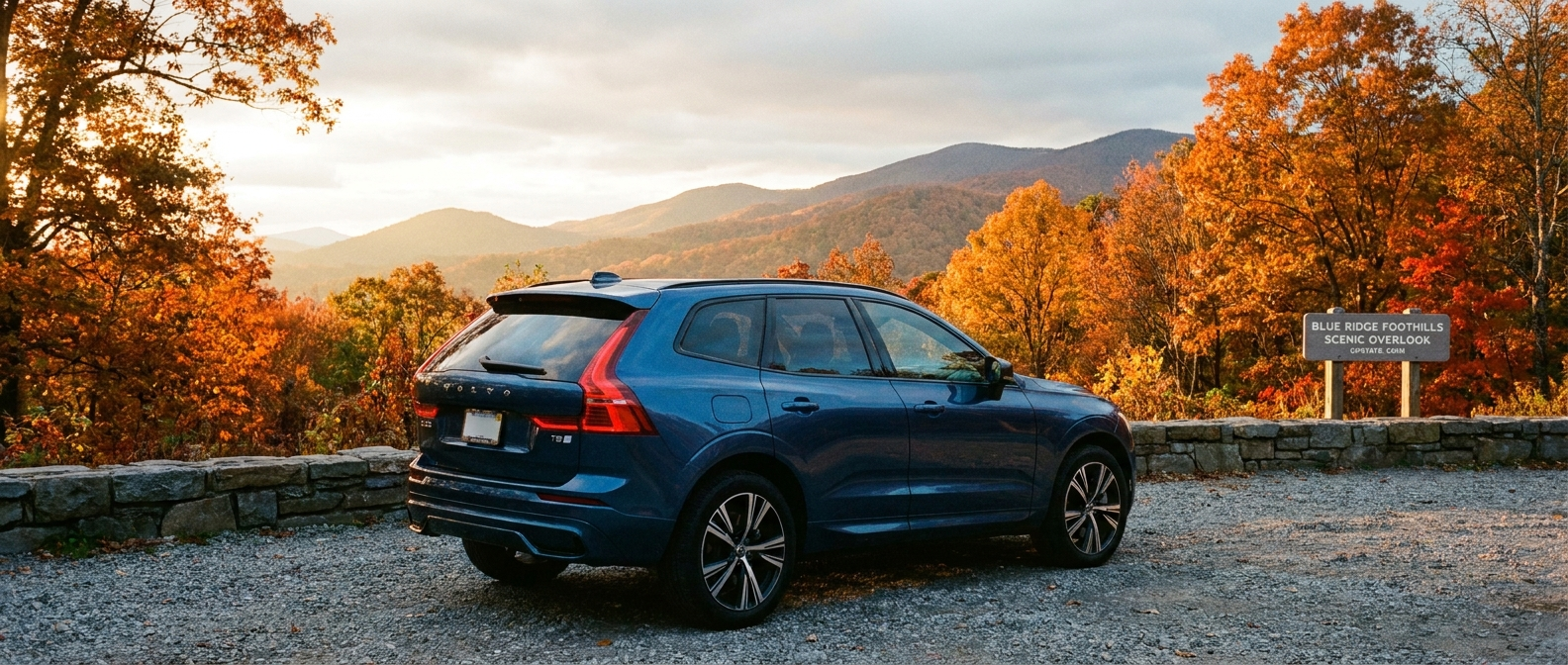
Greenville's October mornings settle right around 50 degrees Fahrenheit. That number matters more than you'd think for a plug-in hybrid SUV.
At 50 degrees Fahrenheit, the 18.8 kWh lithium-ion battery in the 2027 XC60 plug-in hybrid sits in its thermal comfort zone. Summer heat hasn't cooked it, and the sub-freezing cold that can shave 20% or more off a PHEV's electric range hasn't arrived yet. The EPA-estimated 35 miles of pure electric driving on the sticker lands about as close to real-world as it gets in October, in Greenville.
The 2027 XC60 plug-in hybrid delivers an EPA-estimated 35 miles of electric-only range and 69 MPGe combined, and Greenville's autumn temperature window of 50 to 72 degrees Fahrenheit is precisely where PHEV battery efficiency reaches its peak.
What Do These Specs Actually Mean for an Upstate Driver?
A PHEV sticker tells a different story depending on where you actually drive it, and Upstate roads flatter these numbers more than most. Volvo's published figures assume moderate conditions, which is exactly what Greenville hands you in fall, so here's what they translate to once you leave the showroom.
| Spec | 2027 XC60 Plug-In Hybrid (T8 AWD) |
|---|---|
| Combined output | Up to 401 hp |
| Torque | 494 lb-ft |
| 0-60 mph | 4.6 seconds |
| EPA electric range | Up to 35 miles |
| EPA efficiency | 69 MPGe combined |
| Gas-only MPG | 29 mpg combined |
| Battery capacity | 18.8 kWh |
| Level 2 charge time (0-100%) | Approx. 3 hours |
| AWD | Standard (rear axle: electric motor) |
| Towing capacity | Up to 3,500 lbs |
| Cargo (behind rear seat) | 21.1 cu ft |
*Sources: Volvo Car USA specifications, fueleconomy.gov*
The 69 MPGe figure reflects blended gas-and-electric operation. Plug in overnight, keep your daily loop under 35 miles (think Duvall Drive to downtown Greenville and back, with a stop in between), and you may not burn a drop of fuel. The gas engine waits for the longer runs. Nothing about that's a compromise; it's two powertrains doing separate jobs, each one well.
Worth saying plainly, the 35-mile EPA estimate holds up in autumn temperatures. It shrinks in deep winter cold, when the battery has to spend energy keeping itself warm. Greenville rarely sees freezing overnight lows in October, so this really is the right month to talk about what the PHEV delivers.
Pure Mode, Hybrid Mode, and Why the Distinction Matters Here
The XC60 plug-in hybrid offers four drive modes (Pure, Hybrid, Power, Off-Road), and while all four have their moments, only two shape how you'll actually live with the car in Upstate South Carolina. Pure and Hybrid carry the weekdays and the weekends, and understanding that split is what separates a smart PHEV owner from a frustrated one.
Pure mode is what sets this vehicle apart from every mild hybrid Volvo sells. The rear electric motor takes over completely, and the gas engine stays dormant. For in-town running, Falls Park, errands down Main Street, the usual Greenville commute, you get near-silent propulsion and, if you charged last night, fuel use of zero. We notice it most on lower-speed urban stretches, where regenerative braking tops up the battery every time you lift off the throttle.
Keep the system in shape and that regeneration works exactly as designed, season after season.
Hybrid mode is where the engineering earns its keep on longer drives. When the battery's spent and you're heading out to the SC-11 Cherokee Foothills National Scenic Highway for a weekend run through the mountains, the XC60 behaves like a refined hybrid. The EPA puts that figure at 29 mpg combined on gas alone. The engine's 2.0-liter turbocharged four-cylinder keeps the whole system moving, with 401 hp on tap when you need it.
Name the genuine tradeoff up front. Skip regular charging and you lose the thing that makes this powertrain exceptional. Drive it like a conventional SUV without plugging in, and you'll pay the fuel cost of hauling 4,689 pounds on gas alone. The PHEV only justifies itself when you use the plug, which is less a criticism than a plain description of how the technology works.
"The more often you plug in, the better your average fuel economy will be.". EPA, fueleconomy.gov
The AWD Geometry Nobody Mentions in Brochures
Standard all-wheel drive on this PHEV works nothing like the mechanical setup in a conventional AWD crossover, and the difference is worth understanding before you sign anything. There's no driveshaft tying the axles together here; the front and rear draw power from entirely separate sources, which changes how the car behaves when the pavement turns slick.
In the 2027 XC60 plug-in hybrid, the turbocharged gas engine drives the front wheels through an eight-speed automatic. The rear wheels are driven independently by the electric motor. There's no mechanical shaft connecting front to rear. Torque goes where it's needed, electronically.
Compare it to the XC90 plug-in hybrid if you need three rows with the same architecture. The principle's identical, the footprint is larger.
On a damp autumn morning heading into the foothills, the rear motor can deliver torque instantly, before the gas engine's even registered that traction is slipping. Response comes measurably faster than a traditional AWD center differential manages. Out on I-385 in a wet-leaves scenario, you feel that difference rather than just read about it.
Torque at 494 lb-ft is the other number that stands out. Torque moves an SUV from a standstill, and 494 lb-ft arriving at effectively zero RPM from the electric motor is a generous helping. The 4.6-second 0-60 reads like a track statistic, but around here it mostly feels like merging onto I-85 with confidence and no drama.
"All-wheel drive is standard, with the rear wheels driven by electricity.". Volvo Car USA
Who the XC60 Plug-In Hybrid Actually Fits in Greenville
Not every buyer is the right fit for this PHEV, and we'd rather say so now than watch you discover it three months in. The XC60 plug-in hybrid rewards a very specific ownership pattern, so the honest question is whether your daily driving and your home setup line up with what the car does best.
The best fit is an established couple or small family whose daily driving stays inside that 35-mile electric radius. Greenville to Greer, Greenville to Simpsonville, the downtown-to-suburbs loop. They've got a place to plug in at home, or room to add a Level 2 outlet. They value the hush of electric driving around town and the reassurance of 401 hp and AWD on Blue Ridge weekend runs, and they aren't looking for a vehicle that doubles as a cargo hauler or a seven-passenger shuttle.
The limitation is cargo, and it comes down to packaging. At 21.1 cubic feet behind the rear seat, the XC60 plug-in hybrid gives up about half a cubic foot to the mild-hybrid XC60 (the battery pack lives under the cargo floor), which won't faze two adults with a weekend bag but is worth a tape-measure check if you haul gear regularly.
For the reader who wants more range without the plug-in obligation, the mild-hybrid XC60 B5 AWD is a legitimate alternative at 29 mpg combined. For the reader who genuinely wants full-electric daily driving, the EX90 is where that conversation starts.
What the plug-in hybrid gives you that neither of those can is range flexibility of a particular kind. Run silent on electricity through a Greenville workweek, then drive out to Caesars Head State Park on a Saturday without once thinking about range. No other configuration in the lineup pulls off both.
FAQ
Does cold weather reduce the XC60 plug-in hybrid's electric range?
Yes. PHEV battery efficiency falls in sustained cold, especially below freezing, because the pack spends energy heating itself instead of moving the car. Greenville's October average low runs around 51 degrees Fahrenheit, comfortably above the point where range loss gets serious. Expect the winter months (January through February, when Greenville averages overnight lows near 31 degrees Fahrenheit) to trim some pure electric range. Autumn really is the optimal season for PHEV performance in this region.
Is the XC60 plug-in hybrid still called the "Recharge"?
No. Volvo dropped the "Recharge" designation from its plug-in hybrid model names starting with the 2025 model year, now two model years back. You'll buy this one simply as the XC60 plug-in hybrid. The Recharge name still turns up in some marketing and still attaches to Volvo's electrified lineup broadly, but the 2027 model on our lot wears the updated naming.
Categories:
Social