
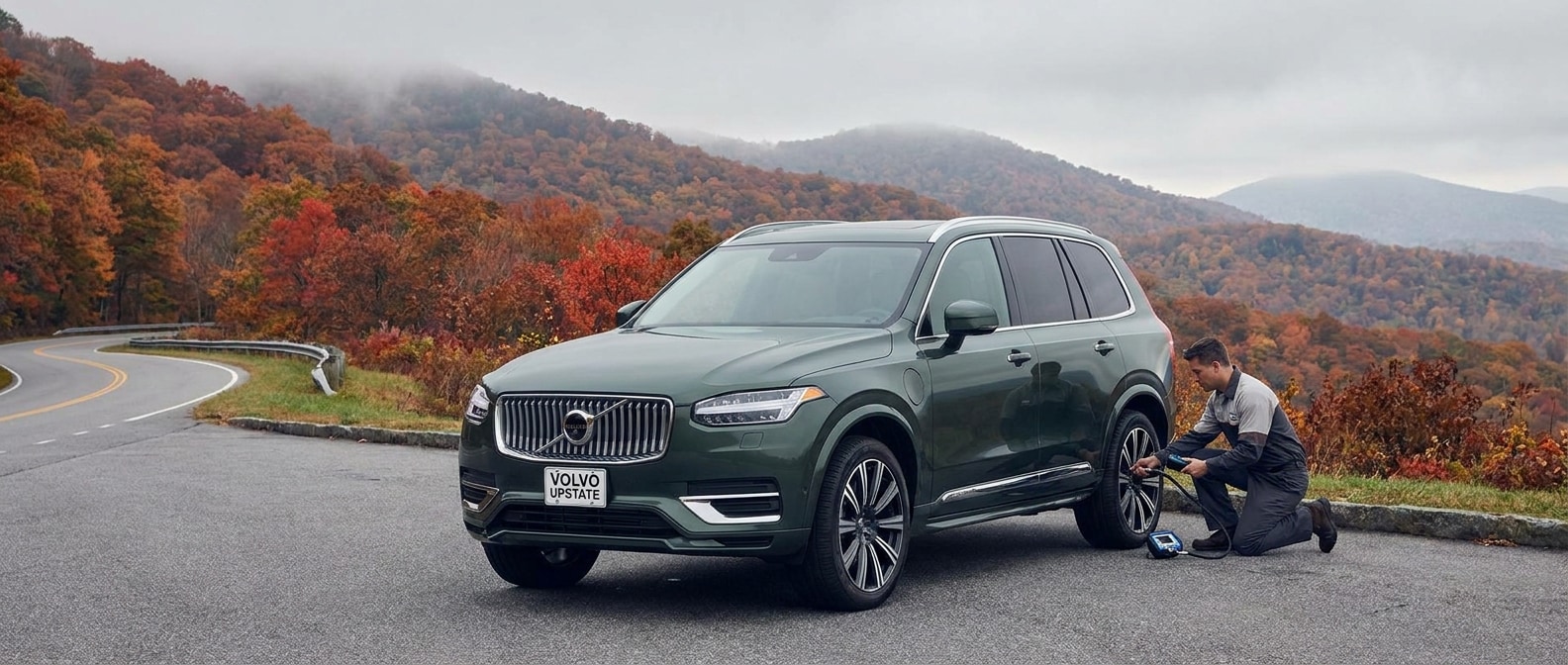
Greenville's autumn temperature swings underinflate your tires without ever lighting a warning on the dashboard. Picture a 75F October afternoon giving way to a 44F November morning, a 30-degree overnight drop. Physics handles the rest, and it doesn't ask permission. For every 10F the temperature falls, your tires lose about 1 PSI, so a 30-degree swing means roughly 3 PSI you'll never see leave while your Volvo sits in the driveway, nobody the wiser.
The part that matters most lives in the fine print. Your Tire Pressure Monitoring System (TPMS) won't alert you until a tire sits 25 percent or more below its recommended cold pressure, per the federal standard that governs all modern TPMS systems. Set a Volvo XC60 to 35 PSI and the warning light stays dark until you've dropped to around 26 PSI. Call it a wide gap between technically fine according to the dashboard and properly inflated for safe handling on a wet I-85 on-ramp.
On a 35 PSI Volvo XC60, the TPMS warning light won't illuminate until pressure falls to roughly 26 PSI. Greenville's fall temperature swings can drain 2-3 PSI without triggering a single alert.
We check tires here at Volvo Cars Greenville every time a vehicle rolls through our service lane, and what shows up through October and November won't alarm you, though it will teach you something. Tires set to spec in September arrive meaningfully soft by the time the leaves on Paris Mountain turn. The car drives fine. Nothing nags from the dashboard. A driver's got no reason to suspect a thing. A check this easy to skip is exactly the one worth doing.
What Do the Tire Pressure Specs Actually Mean?
Your Volvo's recommended cold tire pressure lives on a placard inside the driver's side B-pillar, and that figure is the manufacturer's tested baseline for ride quality, handling precision, fuel efficiency, and even how the tread wears across its face. Treat it as the authority. The number isn't a suggestion, and the car doesn't improvise around it.
| Volvo Model | Recommended Cold Pressure (standard load) | TPMS Alert Threshold (25% below) |
|---|---|---|
| 2026 XC60 | 35 PSI front and rear | ~26 PSI |
| 2026 XC90 (plug-in hybrid) | 38 PSI front and rear | ~28.5 PSI |
| 2026 XC40 | 33-35 PSI (varies by tire size) | ~25-26 PSI |
"Cold" means the tires haven't rolled for at least three hours. Check right after a highway run and you'll get an inflated reading, since friction warms the air inside the tire and nudges the number up for a while. So check before you leave the house, not after you've driven to the gas station.
NHTSA's research establishes that underinflation increases sidewall flexion, which generates heat, reduces handling precision, and stretches stopping distances. At 2/32 of an inch of remaining tread depth, tire pre-crash events occur at a rate three times higher than on tires with adequate tread, per NHTSA crash data. Pressure and tread work together. A soft, worn tire doesn't just double the risk, it compounds it, and the margin you're trusting shrinks fast.
The XC60 Recharge plug-in hybrid carries the same 35 PSI recommendation. Worth flagging, since plenty of owners figure a heavier plug-in model wants more air, and it doesn't. The car knows what it wants, and you'll read it off the B-pillar placard. The sidewall only lists maximum pressure, which differs from the recommended operating pressure.
The Volvo TPMS Recalibration Step Nobody Tells You About
Correcting the pressure is only half the job on a Volvo, because adding air by itself won't always clear the system, and a stubborn warning light can keep glowing on tires you've already topped off to spec in your own driveway. On the XC90 and across the current Volvo lineup, the recalibration step is what you're missing.
Volvo's TPMS runs sensors in the tire valves that read pressure in real time and send data to the vehicle once you're moving above roughly 20 mph. The system works off a temperature-compensated pressure value, so the figure it reads and the figure on your cold gauge can differ slightly. After you reinflate, you'll often need to recalibrate.
Run it in this order.
- Check cold. Tires should be cold, meaning the car hasn't moved in at least three hours.
- Find your placard target. Driver's side B-pillar. Not the sidewall number.
- Inflate to spec (or 2-3 PSI above spec if the TPMS light is already on, per Volvo's temperature-compensation note in the owner's manual).
- Open Car Status in the center display. Tap "Store Pressure," then confirm. This tells the system your new baseline.
- Drive above 20 mph. The system will begin validating pressure against the stored value.
Skip step 4 and the TPMS may keep showing a low-pressure warning on tires that you've already corrected. We've seen it happen in our lane. The fix takes a minute once you know the step exists.
Per Volvo Cars official documentation, the TPMS uses a temperature-compensated pressure value that can differ from the cold-inflation figure on the tire placard. It may be necessary to inflate slightly above the recommended cold pressure (approximately 3-4 PSI) to reset a low-pressure warning.
XC90 Recharge owners on the larger 275/45 R20 or 275/35 R22 tires should confirm their specific placard figure, since the Volvo-published specification shows 38 PSI front and rear for full-load configurations. The temporary spare carries a separate requirement (60 PSI), and you'll want to keep that figure well clear of the primary tire spec; the two don't mix.
Tread Depth: What Fall Rain in Upstate SC Actually Demands
October brings rain to the Upstate, and tread depth is what decides whether your Volvo stops where you'd expect it to on a wet road rather than a few feet past it, which is the difference that matters on a downhill curve. Run tires at 4/32 of an inch and stopping distance on wet pavement climbs by an average of nearly 30 feet against a new tire, according to tire industry testing data. Call it one car length you'll add to every emergency stop.
SC-11, the Cherokee Foothills National Scenic Highway, is one of the most beautiful drives in the region and genuinely slick when wet leaves cover the curves.
The industry-standard replacement threshold sits at 2/32 of an inch. Drop below it and the tires won't pass a safety inspection. Waiting that long still misses the point, because at 4/32 you're already losing measurable wet grip.
The honest tradeoff is worth stating plainly. All-season tires, which is what most Volvo owners in Greenville run year-round, handle light rain well and show their limits once cold rain settles on leaf-covered pavement below about 45F, and you'll feel it. A dedicated winter tire is the technically superior choice for the weeks in January and February when Upstate SC does get occasional ice and overnight frost. For most drivers here, well-maintained all-seasons with healthy tread and correct pressure carry you through Greenville's relatively mild winters in comfort, and they'll usually do the job. The calculus changes on mountain climbs into higher elevations on I-26 toward Asheville, where conditions are genuinely different.
The penny test makes a decent starting point (slide Lincoln's head into a tread groove, and if you can see the top of his head, you're at or below 2/32). The quarter test tells you more. See above Washington's head and you're at 4/32 or less, with degradation already underway.
What to check in this order:
- Tread depth at multiple points across the tire face (center and both shoulders)
- Uneven wear patterns (cupping, edge wear, center wear), which tell a different story about alignment or inflation history
- Sidewall condition, especially on tires exposed to the intense summer UV that Greenville delivers before fall arrives
- Valve stem caps (missing caps let moisture into the valve core, which causes slow pressure loss)
Who Benefits Most from a Fall Tire Check Right Now
If your Volvo mainly works as a Greenville commuter on I-385 and I-85, the pressure correction earns the top spot on this list, because you've spent months running tires inflated to summer temperatures and they're already sitting a touch below spec. A 10-minute cold check and top-off, followed by the Car Status recalibration, puts you back in the range the car was engineered for.
If you point your Volvo toward Blue Ridge runs on fall weekends, you'll want the tread depth check at equal priority. The roads toward Caesars Head and Raven Cliff Falls are spectacular in October, and they're plainly more demanding than a parking lot. Proper tread depth and correct inflation mean the chassis dynamics your Volvo was engineered to deliver are actually there for you on those roads.
Our service team can measure tread depth at four points per tire and give you a straightforward read on where each one stands. No pressure to replace something that doesn't need it. If the tires are fine, we'll tell you.
One thing we can confirm from our lane is that fall concentrates tire-related service needs, and not because anyone's suddenly driving more. The seasonal temperature drop is just the first moment all year when you'll notice a borderline tire showing its hand, through a soft feel in corners, or a TPMS alert that's finally crossed the 25-percent threshold. The condition sat there for months. The temperature just made it visible.
Frequently Asked Questions
Why does my Volvo TPMS light come on in fall even though I just filled the tires last month?
It's almost certainly physics, not a leak. For every 10F the temperature drops, your tire pressure falls by approximately 1 PSI. Greenville's transition from October to November brings average overnight lows from around 54F down to the low 40s. That's a drop of roughly 10-12 degrees on average, and a much larger single-night swing is common. If your tires were right at spec in warm weather, they may now be at or near the 25-percent threshold that triggers the TPMS warning. Top them off to the placard value, then use the Car Status app to store the new pressure and reset the system.
What is the correct tire pressure for a Volvo XC60 or XC90 in fall?
The authority is the tire pressure placard on your driver's side B-pillar, not the tire sidewall or a general guideline. For most 2026 XC60 configurations, Volvo specifies 35 PSI cold pressure front and rear. For the 2026 XC90 on standard and larger tire sizes, the specification is 38 PSI cold front and rear. These figures are for standard passenger loads. If you're using a temporary spare, its pressure requirement (60 PSI) is completely separate and much higher. Check the placard for your specific configuration, as trim levels and tire sizes affect the correct figure.