
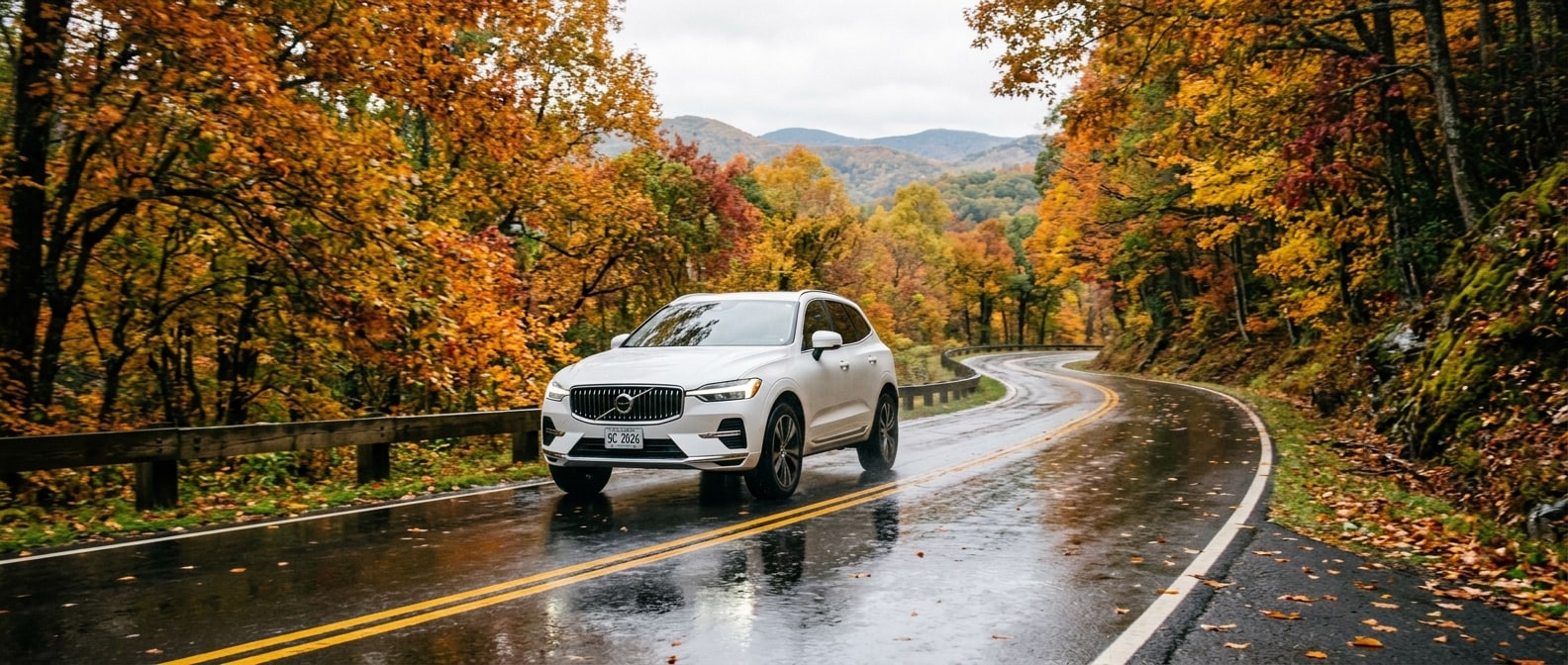
October rolls into Upstate South Carolina and the roads change under you. That same stretch of SC-11 Cherokee Foothills Scenic Highway that felt perfectly manageable in August can carry a mat of wet leaves by mid-October, and the physics under your tires shifts in a way that catches out even seasoned drivers. Wet leaves at 40 mph push stopping distance to roughly 250 feet. On dry pavement at the same speed, you're looking at about 80 feet. This guide walks you through the specific checks and habit changes that keep a Volvo driver genuinely prepared on Upstate roads this fall. Comfort is the easy part. Preparation is the piece worth checking.
Wet leaves cut traction down toward ice levels, and your Volvo's City Safety system and all-wheel drive are real assets when the road turns slick. Neither one, though, replaces correct tire pressure, adequate tread depth, and a wider following gap before you need them.
The 2026 Volvo XC60 comes standard with all-wheel drive across every trim, and that gives you a genuine foundation for fall driving in the Upstate. AWD helps you accelerate and hold momentum through a corner. It won't shorten your stopping distance on leaves. Hold onto that distinction before you head up US-276 toward Caesars Head.
What You Need Before You Start
Run through this table before your first significant fall drive, because the surface you'll meet in October behaves nothing like the August road you remember. These are the specific items, the correct spec to check against, and why each one matters when the pavement changes.
| Item | What to verify | Why it matters in fall |
|---|---|---|
| Tire pressure | Match the door-jamb placard | Temps drop 20 degrees F, pressure drops approximately 4 PSI; underinflation extends braking distance on wet pavement |
| Tread depth | 4/32 inch minimum; 6/32 preferred | Tread below 3 mm increases wet braking distance by up to 35% (AAA) |
| Wiper blades | No streaking or skipping across glass | Shaded mountain curves and fall overcast compress your visibility window fast |
| Headlights | Clean lenses, correct aim | Fall overcast and earlier sunset reduce the time you have to see a hazard |
| City Safety | Confirmed active in driver display | The system should be on before any reduced-traction route |
| Following distance | 4-second minimum on leaf-covered roads | Stopping distance on wet leaves at 40 mph reaches approximately 250 feet |
Tire pressure is the adjustment our service team sees overlooked most often in fall, and we're not floating a volume claim by saying so. The mechanics are plain. A vehicle that sat at 35 PSI all summer can slide to 31 PSI once Greenville mornings cool into the mid-50s, and that 4-PSI shortfall meaningfully changes how the tire's contact patch deforms against wet pavement.
Schedule a Fall Safety Inspection
Setting Up Your Volvo: Six Steps Before You Drive
Work through these in sequence before your first fall drive on leaf-covered Upstate roads, whether that's a foliage run up to Caesars Head or a rainy-morning commute on I-385.
Step 1: Check tire pressure cold, before you move the car.
A warm reading, taken after you've driven, runs higher than actual cold pressure and hides a genuine shortfall. Your target figure lives on the driver-door-jamb placard. The number stamped on the tire sidewall is the maximum allowable pressure, so don't inflate to it. Once Greenville overnight lows settle into the 50s consistently, plan to check again. Pressure keeps following the temperature down.
Step 2: Test tread depth at every corner with a quarter.
Insert a quarter into the tread groove with Washington's head pointing down. If any of the space above his hairline shows, you're sitting at or below 4/32 of an inch. AAA's research puts tread below 3 mm as the threshold where wet braking distance climbs by up to 35% compared with new tires. The 2026 Volvo XC40 and other models in the lineup carry a tread-depth warning in the driver display, but that alert is calibrated for critically low tread, and it won't replace a manual check before the season starts.
Step 3: Replace wiper blades that streak or skip.
Wiper blades are the least expensive item on the list. Greenville's summer UV and steady heat degrade the rubber faster than the calendar does. A blade that looked acceptable in May can be leaving arcs by October. Wet leaf debris also piles onto blades mid-drive, and that intermittent skipping steals glass clarity right when you need it most.
Step 4: Confirm City Safety is active and understand what it actually does.
Every 2026 Volvo includes City Safety as a standard system. It uses cameras, radar, and lidar to scan ahead continuously, spotting vehicles, pedestrians, cyclists, and large animals. The escalation sequence runs from audio and visual warnings, to brake-pedal vibration, to autonomous emergency braking if you haven't responded. That chain of intervention earns its keep. What it can't do is manage traction. On wet leaves, where surface grip drops close to ice, City Safety narrows the gap between your reaction time and full braking force, yet it can't compress the distance your tires need to scrub speed on a low-grip surface.
Volvo's safety architecture is the most comprehensive in the segment, and it still can't out-brake a bad tire. Give it the right rubber in the right condition underneath, or the electronics are working uphill.
Step 5: Build your following distance before you reach the leaf-covered section.
AAA has compared the traction loss from wet leaves directly to ice. The 2-second following gap that felt natural on summer roads doesn't hold up on leaf-covered pavement. A 4-second minimum gap is a reasonable target for Upstate fall routes. On the downhill sections of the Caesars Head approach, where leaf cover sits in tree shadow and stays wet well past noon, 5 seconds gives you a better margin. Build the gap before the leaf-covered section arrives, not once you're in it.
Step 6: Adjust your approach to shaded corners and low spots.
Leaves gather where sunlight never reaches. Shaded curves, tree canopies, and the low points at the base of grades hold leaf cover for days after rain. Slow before the corner, not in it. Mid-corner braking on a leaf-covered surface asks the tires to juggle cornering load and deceleration at the same time, and that combination is where drivers lose directional control.
Schedule a tire and brake inspection at Volvo Cars Greenville before peak foliage. Our team can verify tread depth, cold inflation, and brake-pad thickness in a single visit.
The step most drivers get wrong: The instinct when you feel the surface change is to brake hard, and that's exactly the wrong response. Ease off the accelerator first and use engine braking to gently reduce speed. Hard braking on a leaf-covered surface overwhelms ABS and stretches the stopping event out rather than trimming it. Brake earlier, brake progressively, and build your margin before you need it.
Print-and-Go Fall Checklist
Keep this in the car or photograph it before your first October drive.
- [ ] Tire pressure checked cold, matched to door-jamb placard
- [ ] Tread depth tested with the quarter method at all four corners
- [ ] Wiper blades inspected; no streaking or skipping
- [ ] Headlights clean and correctly aimed
- [ ] City Safety confirmed active in the driver display
- [ ] Following distance plan in place: 4 seconds minimum on leaf-covered routes
- [ ] Route previewed for shaded corners, downhill grades, and leaf-accumulation zones
- [ ] Speed reduction committed before curves, not during them
A Quick Recap Before You Head Out
The physics of wet leaves aren't complicated, but they get underestimated all the time. At 40 mph, a car on wet leaves needs roughly 250 feet to stop. The same car on dry pavement stops in about 80. Your Volvo's all-wheel drive, City Safety, and Blind Spot Information System each cut your exposure in different scenarios. None of them change the grip available between a worn or underinflated tire and a leaf-covered road. Preparation changes the outcome, correct tire pressure, adequate tread, clean visibility, and a 4-second gap before the hazard arrives.
SC-11 in October, with the Cherokee foothills turning gold and orange around every switchback, ranks among the finer drives in the Southeast. Browse our current Volvo inventory when you're ready to take it in a vehicle engineered specifically for this kind of confident, composed fall drive.
By the Volvo Cars Greenville Team | September 2026
Frequently Asked Questions
Does AWD help on wet leaves?
All-wheel drive improves your ability to accelerate and maintain momentum on slippery surfaces, and it helps all four tires contribute during cornering. It doesn't shorten stopping distance. On wet leaves, braking performance depends on tire tread depth, tire pressure, and the available grip between the tire and road surface. A Volvo with standard AWD still requires as much distance to stop on wet leaves as it does on ice if the tires are at the wrong pressure or the tread is marginal.
Does Volvo's City Safety system activate on wet leaves?
City Safety monitors the road ahead using cameras, radar, and lidar, and it can apply emergency braking when it detects an imminent collision. Traction management sits outside its job. On a low-traction surface like wet leaves, the system can still intervene and reduce collision severity, though the deceleration available is limited by the grip between your tires and the road. Correct tire condition and a wide following distance remain the primary preparation. City Safety is a last-resort intervention chain, and it works best once driver preparation has already reduced the exposure.
Categories:
Social