
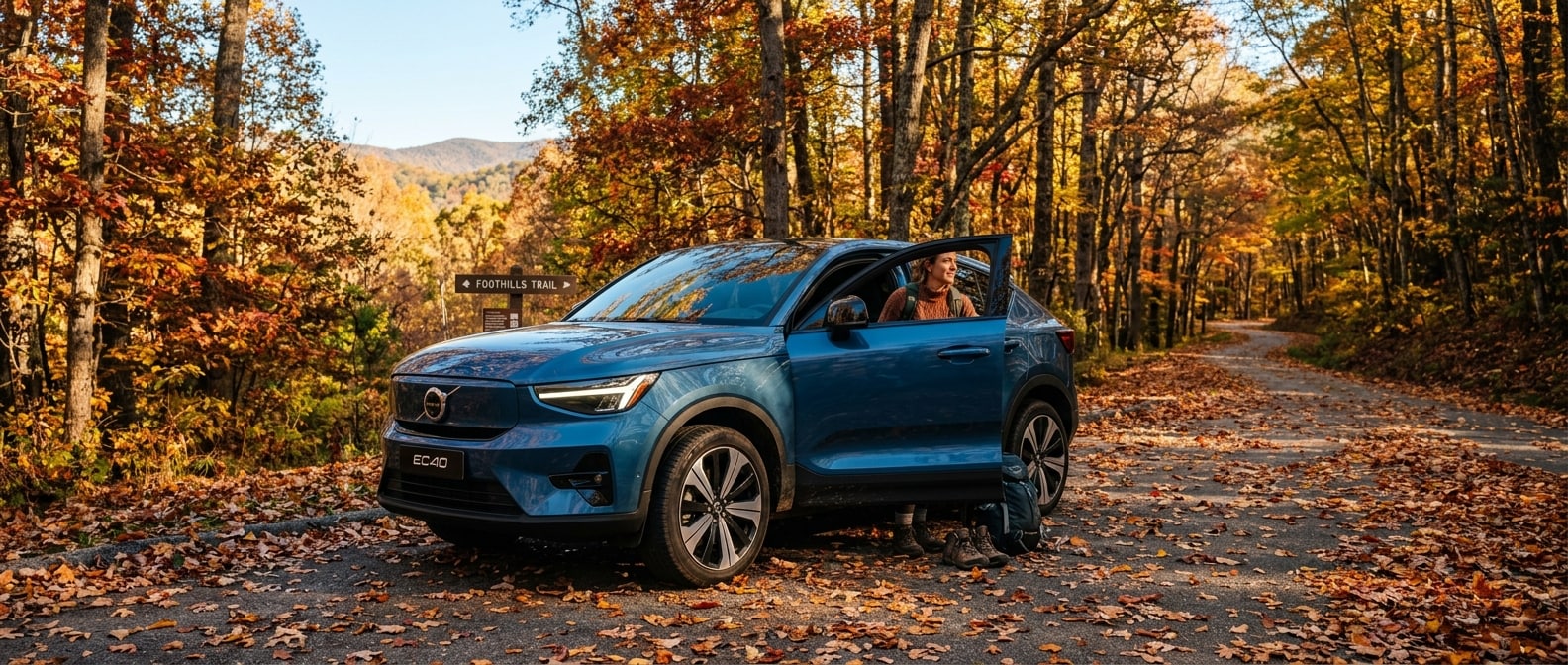
One naming note before we get into it. For 2026, Volvo renamed the C40 Recharge the EC40 in the US market. The coupe-crossover architecture carries over, the all-electric powertrain carries over, and the Scandinavian character carries over. New badge, courtesy of Volvo's updated EV naming strategy. If you've been researching the C40 Recharge, you're already looking at the right car, and everything in this guide applies directly. We'll use both names, since Upstate buyers search both.
Bottom line, the EC40 is a genuinely capable fall and winter driver in Greenville's climate, with one caveat worth understanding before the temperature dips below 55 degrees F overnight.
Check current EC40 availability at our Greenville showroom
Greenville's cooler season isn't what EV horror stories are written about. We're not talking about a Minnesota January. We're talking about something far milder. By late September, overnight lows are dropping toward the upper 50s, and by October they settle into the low-to-mid 50s. That's the window where the EC40's NMC lithium-ion battery starts pulling a little extra energy to keep itself at operating temperature. Not a crisis. But it does mean the playbook that got you 298 miles of EPA-rated range in July needs a small revision.
Knowing when to revise it (and how) is the whole point of this guide.
When Should You Adjust Your Routine, and By How Much?
The EPA rates the 2026 EC40 Single Motor at 298 miles of range under standard conditions, a figure that's real and government-verified. In Greenville, you'll see something close to it from late spring through early September, when overnight temperatures stay well above 60 degrees F. As the Upstate transitions into fall, the numbers shift.
Research into EV battery behavior in mild cool conditions (the 40-to-55 degrees F range most Greenville nights occupy from October through February) consistently shows a 10-to-15% reduction from warm-weather figures. On the EC40 Single Motor, that puts your practical working range at roughly 250-to-270 miles on a cool morning start. The Twin Motor AWD's 268 miles EPA rating shades to about 225-to-245 miles in the same conditions. Those are still generous numbers for Upstate day-to-day life and a run up SC-11 Cherokee Foothills National Scenic Highway on a Saturday.
The tradeoff is worth stating plainly. You're not losing your car's capability. You're losing a planning margin that most local driving never touches anyway. On a longer autumn day trip, though, particularly if you're starting with the car cold in a garage overnight, that margin narrows and it's worth accounting for.
Our team's recommendations follow, sorted by the conditions you're actually going to face in Upstate SC.
| Greenville Condition | What to Do | Range Effect | Key Tip |
|---|---|---|---|
| Overnight low 55-65 degrees F (Sept-early Oct) | Charge to 90%, standard morning routine | Minimal change, under 5% reduction | No special action needed |
| Overnight low 45-55 degrees F (Oct-Nov mornings) | Schedule cabin and battery preconditioning for 15 min before departure | Recovers 8-12% of cold-weather loss | Use the Volvo Cars app while plugged in so grid power handles the warm-up |
| Overnight low below 45 degrees F (Dec-Feb) | Precondition, charge to 90-95%, plan DC charging stops on trips over 200 miles | 10-15% reduction from EPA figure | Navigate to chargers via the car's built-in Google Maps so the battery self-conditions for fast charging |
| DC fast charging in the cold | Route via the car's navigation to the charger (do not just drive there cold) | Charging curve stays close to the 200 kW peak | A cold-soaked battery charges noticeably more slowly without this step |
| One-Pedal Driving mode | Activate it, especially in Greenville stop-and-go | Regenerative braking adds recoverable range | Works at any temperature; regen benefit actually amplifies in cool, dense air |
The Fit and Maneuvering Reality in Downtown Greenville
The EC40's roofline is what sets it apart visually, and it's also the one physical spec that shapes how the car handles parking in tighter Upstate spots, which is worth knowing before you head downtown on a fall Friday evening when the West End fills up.
At 63 inches tall (the coupe roofline runs lower than the XC40's more upright SUV stance), the EC40 clears almost every parking structure in Downtown Greenville without concern. The compact footprint means you're not hunting for the oversized end-of-row slot. The EC40 is right-sized for the street-level spaces near Falls Park. That coupe shape is shorter than the EX90 by a meaningful margin in both height and length, which matters when you're parallel-parking on Main Street after a Falls Park walk.
The tighter rear-quarter sight lines from that sloping roofline are the one trade. The back-up camera and corner sensors handle it, but if you're new to the car, the first few reverse maneuvers in a tighter space go better when you slow down and let the sensors catch up. We point this out because the surprise is less about the technology and more about learning to trust it at parking-lot speeds.
One practical note for fall outings. Cargo space behind the rear seats is 14 cubic feet, which is honest hatchback-style utility rather than proper SUV volume. That's enough for two light packs on a day at Paris Mountain State Park. It's not enough for four people's gear plus a full week of supplies. Know your load before the trip, not after.
Insider tip (where to park): Street-level spots on North Main and around the West End suit the EC40's compact footprint on fall evenings. If you're headed to Falls Park, the Camperdown garage at the western end of the bridge is your most efficient option. The EC40 fits cleanly on every level without the clearance guesswork some taller vehicles face.
Etiquette note for EV drivers: When a downtown charging station is occupied by a car that has clearly finished charging, a polite note under the wiper (or a quick check of the Plug Share network for real-time status before you leave) is the actual solution. Moving someone's car for them never is, even in Greenville.
At Greenville's typical October overnight lows of 45-55 degrees F, preconditioning the EC40 while plugged in for 15 minutes before departure recovers most of the cold-weather range reduction at no cost to the battery.
Your Fall-Ready Pre-Drive Checklist
The checklist below is short by design, because keeping the EC40 efficient through Greenville's cooler months takes a habit rather than a ritual, a couple of things you glance at the night before and one or two you set while the car is still plugged in. You don't need a ceremony. You need a habit.
- Check the overnight low the evening before. If it's dropping below 50 degrees F, open the Volvo Cars app and schedule preconditioning. Set it to finish five minutes before you plan to leave.
- Confirm your charge level. For everyday Greenville commuting, 80-to-90% is the right daily ceiling; it protects battery chemistry and leaves you a buffer. On the morning of a longer run to Caesars Head or the lakes, charge to 90-95% the night before.
- Activate One-Pedal Driving before you pull out. It lives in the drive mode settings and takes about four seconds. In October traffic, it makes a measurable difference.
- Plan your DC charging stop in-navigation, not ad hoc. The EC40's built-in Google-powered navigation tells the car where you're going so it can precondition the battery pack for the charger before you arrive, which keeps the charging session at or near peak speed. Book a seasonal EV service check before a longer fall road trip. Our service team confirms battery, tire pressures (which drop about one PSI per 10 degrees F of temperature change), and all-season traction systems.
- Tire pressure first. A car sitting in a 50 degrees F garage overnight has likely lost 2-to-3 PSI from its summer pressure. The EC40 will alert you at a meaningful threshold, but a check at the start of each cool-weather month is the quieter way to keep efficiency exactly where it should be.
- Go enjoy it. Autumn in Upstate SC is genuinely one of the best stretches of the year to be in an electric vehicle. The cool, dense air makes regenerative braking more responsive, and the cabin's heat pump manages the temperature load efficiently. The car is built for this.
Categories:
Social